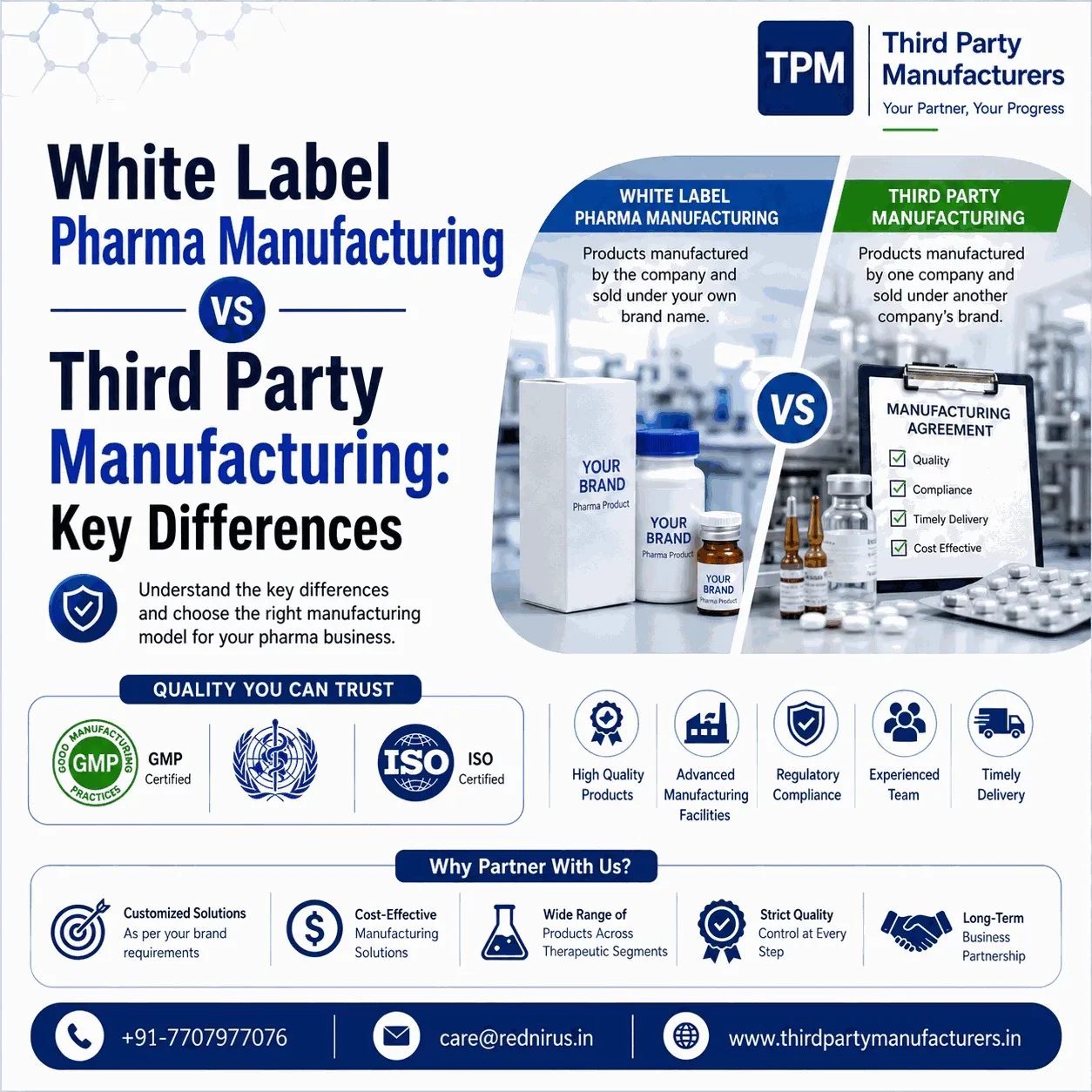
White Label Pharma Manufacturing vs Third Party Manufacturing differ mainly in branding and product ownership. In white label manufacturing, ready-made products are sold under your brand, while third party manufacturing produces customized medicines based on your requirements. The right choice depends on your business goals, product customization needs and investment strategy.
The white label pharma manufacturing is among the quickest ways to introduce branded products into the market without even installing a machine. Most new entrants into the pharma industry find it difficult to distinguish white label manufacturing from regular contract manufacturing because the two have outsourcing as the core of the production process. The two models vary greatly in terms of ownership, customization, right to branding, and business control. You must understand the difference between the two models before you commit to a deal with any manufacturer because making the wrong decision will definitely cost you dearly.
What is White Label Pharma Manufacturing?
White Label Pharma Manufacturing is the scenario whereby a manufacturer manufactures a pre-formulated product that already exists in their catalogue, and then repacks it under your name. The product formulae, dosage and manufacturing process remain the same. It does not involve any form of designing but choosing from what already exists.
It is almost the same as the concept of Private Label Pharma Manufacturing whereby the manufacturer allows you to put your trademark, packaging, and branding on the pre-existing formulation. The key difference between the two terminologies is minimal. White labelling mostly involves selling the same product to various brands but changing the label, whereas the other concept may give room for slight modifications in the product's packaging design or even formulae. They are both favoured by new PCD Pharma company’s owners and small-scale distributors looking to make it to the market without investing time and effort in researching and developing new products.
The biggest advantage of White Label Pharma Manufacturing is speed. As the product already exists and has been tested, it becomes possible to launch the product using your own brand in a matter of weeks. The concept is equally suited to entrepreneurs who would like to experiment with different categories of products, such as tablets, syrups, or ayurvedic products.
What is Third Party Manufacturing in Pharma?
However, Pharmaceutical Third Party Manufacturing, popularly referred to as 3rd Party Pharma Manufacturing, functions differently. In this situation, as the owner of the brand, you submit your formulation, specifications, or product concept to the manufacturer, who then manufactures the products only for you. This is commonly referred to as Pharmaceutical Contract Manufacturing where there exists an actual contract between the brand owner and the manufacturing unit specifying everything about the product.
While in white labelling, you select the products according to the catalogue, in Third Party Manufacturing, you have more control over the end product. You are at liberty to formulate the product, decide the packaging material, select the pack size, and even demand unusual combinations. This makes it the preferred route for pharma companies that want a distinct product identity rather than a product that is also being sold by other brands under different names.
Many Third Party Manufacturing Pharma Companies also offer flexible batch sizes, which is why the option of Third Party Manufacturing with Low MOQ has become popular among small and mid-sized pharma businesses. A low minimum order quantity allows new entrants to test a product in the market without locking up large amounts of capital in a single production run. This is especially useful for businesses that are just starting their Pharma franchise or want to introduce a new product range on a trial basis before scaling up.
Key Differences Between White Label and Third Party Manufacturing
While both models fall under the broader umbrella of outsourced pharma production, the differences matter a lot when you are choosing a business path.
Ownership and Customization
In White Label Pharma Manufacturing, the formulation belongs to the manufacturer, and you are simply buying the rights to sell it under your name. In Pharmaceutical Third Party Manufacturing, the formulation can be developed according to your specifications, giving you more ownership over the product's identity, even though the physical manufacturing still happens at the third party unit.
Investment and Minimum Order Quantity
White labelling generally requires a smaller initial order since the product is already in production for multiple clients. Third Party Manufacturing with Low MOQ has also made contract manufacturing more accessible, but customized formulations may still involve slightly higher minimum quantities compared to picking a ready-made white label product, since the manufacturer needs to set up a dedicated production run.
Quality Standards and Certification
Whichever method you decide to go with, either White Labelling or Third Party Manufacturing, you must deal only with manufacturers who are certified by the WHO GMP Third Party Manufacturing certification. This means that the manufacturer’s facility has met the required international standards of hygiene, documentation, quality control and safety in manufacturing procedures. Reputable Third Party Manufacturing Pharma Companies will always be forthcoming with regard to their certifications and quality audits.
Branding Flexibility
Third Party Manufacturing generally offers more branding freedom because the formulation itself can be tailored, along with the packaging, dosage form, and combination of ingredients. White Label Pharma Manufacturing, while faster, limits you to what is already available in the manufacturer's product basket.
Which Model Should You Choose for Your Pharma Brand Manufacturing?
Depending on the stage of your business and your business goal, the correct decision can be made. If you are an inexperienced entrepreneur wishing to start up quickly and with minimum risks involved, White Label Pharma Manufacturing and Private Label Pharma Manufacturing may be the better starting point for you. You get access to tested, ready formulations and can begin selling almost immediately.
On the other hand, if you already have a clear product vision, a specific combination in mind, or you want to build a brand that stands apart from competitors selling the same white-labelled products, Pharma 3rd Party Manufacturing is the stronger long-term route. It allows your brand to grow with formulations that are not identical to what every other franchise owner is selling in the market.
Many established businesses actually use a mix of both models — starting a few fast-moving categories with white labelling while developing their flagship or high-margin products through dedicated Third Party Manufacturing Pharma Companies.
How to Choose the Best Third Party Manufacturing Companies in India?
Whether white labelling or complete customization is being looked at, the manufacturing company one chooses makes all the difference. Here is what needs to be verified before making any agreement.
Ensure WHO GMP third party manufacturing certification, as well as ISO and, if required, USFDA certification. Ensure that the manufacturer has worked in your particular therapeutic area such as tablets, injectable, syrup, or ayurvedic formulations. Ask about their minimum order quantity policy, especially if you want the flexibility of Third Party Manufacturing with Low MOQ. Review their turnaround time, packaging capabilities, and whether they provide documentation support for licensing and regulatory filings.
Looking for the Best Third Party Pharma Manufacturers in India? It will be helpful to evaluate more than one company through a reliable B2B portal instead of going with just one referral. By doing so, you will be able to know their prices, certifications, and product range so that you can do an evaluation of different companies and not choose the first company that catches your eye. A website that features third party manufacturing companies that are WHO-GMP certified will enable you to save weeks of research and help you select the best companies from India for your products.
Frequently Asked Questions
Q1: Is White Label Pharma Manufacturing cheaper than Third Party Manufacturing?
Ans: Generally, yes. White labelling uses existing formulations and shared production runs, which lowers upfront costs. Third Party Manufacturing, especially with custom formulations, may cost more but offers greater product ownership and brand differentiation in return.
Q2: Can I customize packaging in White Label Pharma Manufacturing?
Ans: Yes, packaging and branding can usually be customized even in white labelling. However, the formulation itself remains fixed, unlike Pharmaceutical Third Party Manufacturing, where both packaging and formulation can be tailored to your requirements.
Q3: What is the minimum order quantity for Third Party Manufacturing with Low MOQ?
Ans: This varies depending on the company and product, but there are many Third Party Manufacturing companies that are pharma companies today that provide batch sizes for testing products before producing in larger batches.
Q4: What is the importance of WHO GMP certification while selecting a manufacturer?
Ans: WHO GMP Third Party Manufacturing certification means that the manufacturer is following all the international standards of quality, hygiene, and documentation. It is very important for protecting your brand name and providing consistency in your products.
Conclusion
Both models have some real benefits and one isn’t necessarily better than the other. Both options depend on whether you like to control your formula, how much investment you have to make, and how quickly you need to get started. “White Labelling” suits those who work quickly and economically, but “Third Party Manufacturing” is more appropriate for those who need a unique product. Whichever route you opt for, make sure you validate certificates, evaluate options from the Best Third Party Manufacturing Companies in India, and check the flexibility of MOQ. It’s wise to be well-informed right now in order to build a successful pharma business in the future.
Must Read: Top Third Party Manufacturing Pharma Companies in Haridwar
What is White Label Pharma Manufacturing?
White Label Pharma Manufacturing is the scenario whereby a manufacturer manufactures a pre-formulated product that already exists in their catalogue, and then repacks it under your name. The product formulae, dosage and manufacturing process remain the same. It does not involve any form of designing but choosing from what already exists.
White Label Pharma Manufacturing vs Third Party Manufacturing differ mainly in branding and product ownership. In white label manufacturing, ready-made products are sold under your brand, while third party manufacturing produces customized medicines based on your requirements. The right choice depends on your business goals, product customization needs and investment strategy. The white label pharma manufacturing is among the quickest ways to introduce branded products into the market without even installing a machine. Most new entrants into the pharma industry find it difficult to distinguish white label manufacturing from regular contract manufacturing because the two have outsourcing as t...
Key takeaways
- What is White Label Pharma Manufacturing?
- What is Third Party Manufacturing in Pharma?
- Key Differences Between White Label and Third Party Manufacturing
- Which Model Should You Choose for Your Pharma Brand Manufacturing?
- How to Choose the Best Third Party Manufacturing Companies in India?
How to order White Label Pharma Manufacturing vs Third Party Manufacturing: Key Differences
- Define the product Fix the composition, dosage form, pack size, quantity and your brand name.
- Shortlist manufacturers Compare WHO-GMP certification, product permission, capacity and location.
- Compare quotations Ask for the per-unit rate, MOQ, lead time and packing material cost in writing.
- Approve artwork and sample Finalise label, carton and MRP, and approve the pre-production sample.
- Receive your batch Pay the agreed advance and receive goods with invoice and certificate of analysis.