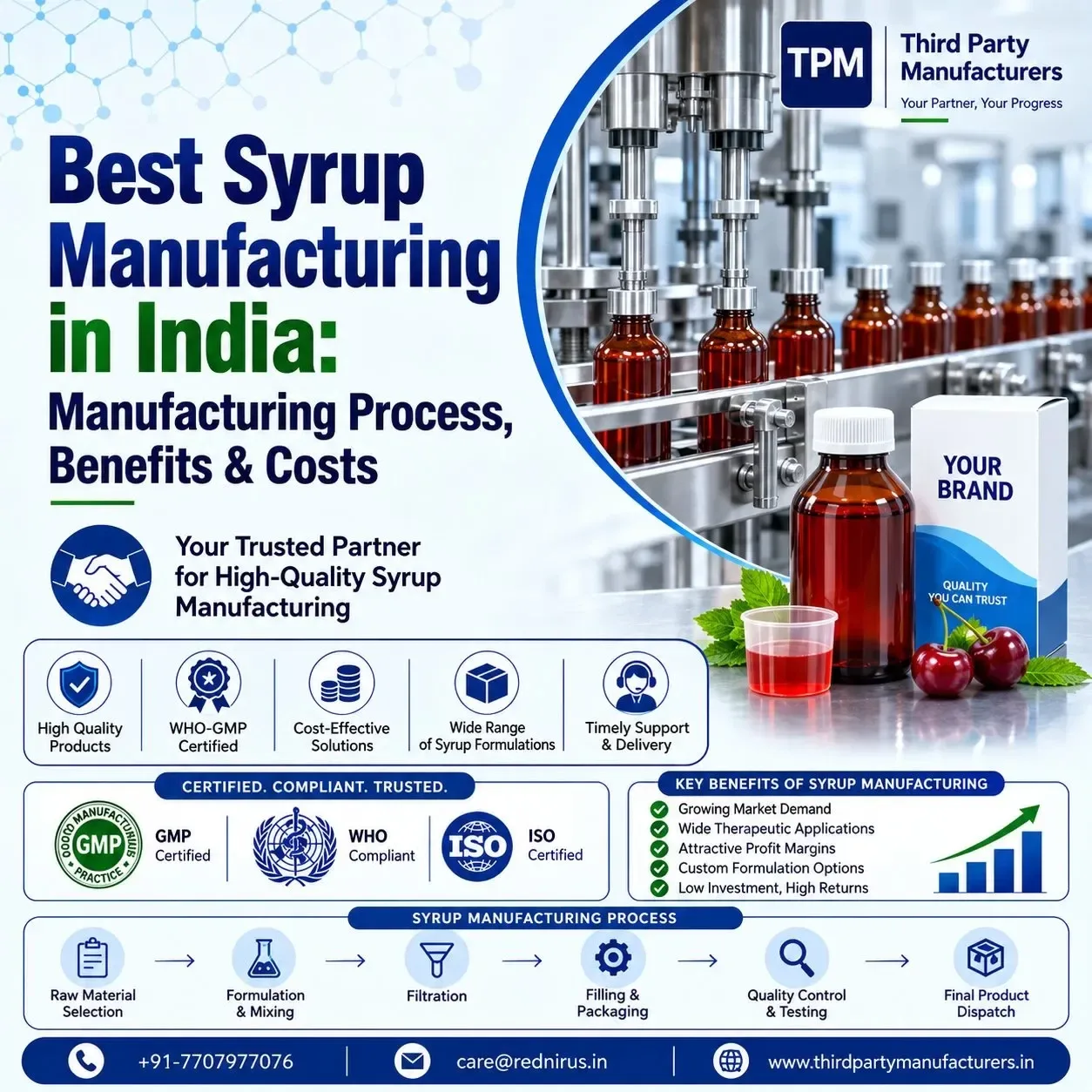
The best syrup manufacturing in India combines standardized formulation, quality raw materials, controlled mixing, filtration, filling, and packaging. Key benefits include consistent product quality, scalable production and cost efficiency. Manufacturing costs depend on formulation, ingredients, packaging, batch size, quality requirements and regulatory compliance.
Syrup Manufacturing in India has become one of the most dependable sectors of the pharmaceutical and FMCG industry on account of the increasing need for cough syrups, pediatric range, tonics, and even flavoured syrups that can be used in the food industry. Liquid dosage forms have remained a favourite form because of their ease of ingestion and absorption as well as simple dosage management. Entrepreneurial ventures joining this business have been opting to go into partnership with a reputable Syrup Manufacturing Company rather than setting up their own in-house manufacturing facility because this helps to lower the initial capital expenditure while providing quality GMP-certified and exportable products. This blog provides details on how to manufacture your own pharma brand with third party manufacturing.
What is Syrup Manufacturing in India and Why It Matters?
In essence, syrup manufacturing is all about transforming active compounds, sugar/sugar-substitute base, flavours, and preservatives into a stable and palatable form of liquid dosage administration. As opposed to tablets and capsules, syrups require exact control of viscosity, pH, microbial levels, and taste masking; hence the reason why the syrup manufacturing process is mainly undertaken by specialized syrup manufacturers having specialized facilities designed for liquid processing.
It is due to low costs of production, expertise of formulation chemists, and regulations geared towards WHO-GMP and Schedule M compliance that India has positioned itself as a global centre of excellence in this category. Regardless of whether the need for the product is an antibiotic suspension, an antacid syrup, or wellness tonics, a competent pharmaceutical syrup manufacturers company can produce large volumes without compromising on quality from batch to batch. That is precisely the reason why most brand owners, franchise companies, and even nutraceutical startups prefer outsourcing to India as opposed to building a production plant from the ground up.
The other reason why this category has experienced rapid growth has to do with its diverse applications. Antibiotic suspensions require precise formulation suitable for injection while shelf stable tonics with a long expiry period are needed for retail pharmacies. Export customers require products formulated differently according to their climatic conditions. The manufacturer of such products needs to address all these concerns from a quality standpoint within a single process, something that can only happen with standardized SOPs, trained personnel and equipment that can be validated across multiple categories of products.
The Step-by-Step Process of Syrup Manufacturing in India
An insight into how the Syrup Manufacturers, really done is very useful for potential clients while assessing their manufacturing partner. The basic steps that are undertaken within a typical Syrup Manufacturing Plant include:
- Raw material sourcing and testing: Active pharmaceutical ingredients, purified water, sugar, and excipients are acquired from certified suppliers and tested for purity before processing.
- Formulation and blending: The ingredients are dissolved in an appropriate order to avoid any adverse interaction, using jacketed stainless-steel tanks with specified temperature and speed of agitation.
- Filtration and clarification: The bulk syrup is passed through a fine filter to remove impurities and maintain its optical clarity, which is essential in a Liquid Syrup Manufacturing Plant.
- In-process quality controls: The values of pH, specific gravity, viscosity, and assay are verified according to the specification before filling.
- Filling and sealing: The syrup is filled into bottles using automated volumetric fillers, after which the cap is sealed and the tamper-evident band is applied.
- Labelling, coding, and packing: Batch number, manufacturing date, and expiry date are coded on each unit and then packed into shipper cartons.
The same process with variations in formulations, can be used when producing either a therapeutic drug or food products by Chocolate Syrup Manufacturers because the products require clean processing, accurate dosing, and stability. All the stages are captured in a batch manufacturing document, which becomes the starting point for any audit during regulation and provides complete traceability in case any customer issues are raised.
There is also an issue of controlling the temperature. Many of the active ingredients become unstable if the temperature exceeds a certain level, and thus the formulation vessels have a jacketed heating and cooling system to maintain the required temperature range through the entire dissolution process. The operators are also trained to check the formation of foam during rapid mixing because foam inside the syrup will create problems while filling the bottles.
Cough Syrup and Other Specialised Formulations
When it comes to syrups, cough and cold syrups have been the most consumed range of syrups in India. An efficient Cough Syrup Manufacturer manufactures various kinds of syrups like expectorant, antitussive and mixed kinds of cough syrups for adults and children alike, which means that there should be different stability and taste for each kind of syrup.
Since respiratory syrups are always closely watched by regulatory bodies, a true Cough Syrup Manufacturing Company should have segregated areas in the plant and proper cleaning procedures in place to avoid contamination between batches. While choosing a partner for your brand, you must demand the WHO-GMP certificate from the plant, portfolio and lab test reports of products before proceeding with the purchase based on prices alone.
The seasonality of demand makes matters even more complicated in this case. Cough & Cold cases see an incredible rise during monsoon and winter seasons, which implies that the manufacturing company must have sufficient tank filling capacity to cope with the rush orders without affecting the dispatch schedule. Such manufacturing facilities that coordinate their production schedules on the basis of seasonality patterns, as opposed to treating every order independently, are able to provide much more reliable delivery schedules to their franchisees and distributors.
Liquid Oral Manufacturing: More Than Just Syrups
Liquid Oral Manufacturing is not restricted to cough syrups but also involves suspensions, emulsions, drops, and elixirs. A well-equipped Liquid Oral Manufacturing Plant consists of modular manufacturing lines, which help in quick conversion from thick suspensions to thin fluids without compromising on hygiene standards.
Liquid Oral Manufacturing also includes selection of the appropriate packaging materials, as some formulas are prone to interaction with particular types of plastic or need to be packaged in amber glass bottles due to sensitivity to light. That is why experience counts: a seasoned Liquid Oral Manufacturing partner already has the information on the compatibility of packaging materials with various types of formulas for therapeutic categories at their disposal.
This is yet another process wherein a seasoned manufacturing facility has its added benefit. Prior to a product’s launch in the market, samples of the same are subjected to stability studies under accelerated and normal conditions to ensure that the drug maintains its efficacy, colour, and flavour throughout its entire shelf life. This means that if a company has its own stability chambers and lab for analysis, then the process would become shorter compared to those companies that outsource testing services.
Key Benefits of Outsourcing to Third Party Pharma Manufacturing
Some of the benefits of opting for Third Party Pharma Manufacturing over setting up one's own facility include:
- Low capital outlay: There is no need to incur costs running into crores for machines, clean rooms, and licenses when one can make use of a Syrup Manufacturing Plant that is available elsewhere.
- Speedy market launch: The formulation and manufacture can commence in a matter of weeks compared to the period of a year that is required to commission a new facility.
- Compliance issues sorted: A reputed third party manufacturer would have received WHO-GMP, ISO and DCGI approvals.
- Quantity flexibility: Brands can initially order in low quantities and then ramp up gradually based on demand rather than being tied down to specific quantities.
- Formulation assistance: Reputed third party pharma manufacturing companies will come with in-house research and development facilities to assist with formulation.
This is a model that has proved to be very popular within the pharma franchise companies that are engaged in PCD all around India, as they like to engage themselves in marketing and distribution, leaving the production process to be taken care of by specialized departments. The other companies that are entering into adjacent segments like vet syrups and nutraceutical tonics would find this model very effective.
Cost Factors in Syrup Manufacturing Plant Setup and Outsourcing
The cost varies greatly depending upon the type of arrangement being considered between the company and either the establishment of their own unit or the use of an existing manufacturer for producing the syrup in bulk. The establishment of a new Liquid Syrup Manufacturing Plant would require huge investments in terms of land/shed rent, HVAC and clean room system, processing and filling machines, water treatment plant, along with licensing costs that could be several crores of rupees prior to production.
On the other hand, the contract production through an already existing Syrup Manufacturing Company will substantially reduce initial investments. Cost will be charged on a per-litre or per batch basis and will also include raw material cost and packaging cost, while the minimum order quantity would differ from one manufacturer to another. Other cost components include complexity of the formula used, packaging material (PET bottles/glass), flavouring requirement and cost for special designing of carton and labelling. The buyer must always ask for the cost.
Taking into account other costs apart from those incurred in making the first shipment will also be beneficial, especially the costs that will have to be incurred in re-testing other batches in case they need to be sent out, storage costs should shipping be delayed, and freight costs due to the extra weight associated with shipping the bulky glass bottles instead of the lighter PET packages. It will also be beneficial for brands that know how much they will be producing annually.
Frequently Asked Questions
Q1. Which are the licenses needed to set up Syrup Manufacturing in India?
There is a requirement of drug manufacturing license according to Schedule M, WHO-GMP compliance and state FDA license. There is no requirement of any other license for companies who want to outsource to third party manufacturers since they just require a wholesale drug license.
Q2. How is a Cough Syrup Manufacturer different from a syrup manufacturer in general?
A cough syrup manufacturer specializes in producing respiratory syrups with stability data and segregation of production area along with experience of taste masking of bitter actives whereas a general syrup manufacturer could be making tonics or nutritional supplements etc.
Q3. Is Third Party Manufacturing cost effective for small brands?
Yes, third party manufacturing reduces capital investment in equipment and licensing for small brands. These brands would still get GMP production facility, packaging services and tested formulations without requiring high minimum order quantities.
Conclusion
Syrup Manufacturing in India has become a highly regulated industry that meets a wide range of needs, from pediatric cough formulations to syrups in chocolates for the food industry. No matter whether a company opts to have its own plant or go in for a partnership with Dry Syrup Manufacturers in India, it is very important for it to be fully aware of the manufacturing process, quality standards as well as the real cost structure. It is always a better choice for most of the new entrants and franchises to have a third party pharma manufacturing company as their partner.
Must Read: How to Find Right Third Party Manufacturing Pharma Company in India?
What is Syrup Manufacturing in India and Why It Matters?
In essence, syrup manufacturing is all about transforming active compounds, sugar/sugar-substitute base, flavours, and preservatives into a stable and palatable form of liquid dosage administration. The best syrup manufacturing in India combines standardized formulation, quality raw materials, controlled mixing, filtration, filling, and packaging.
The best syrup manufacturing in India combines standardized formulation, quality raw materials, controlled mixing, filtration, filling, and packaging. Key benefits include consistent product quality, scalable production and cost efficiency. Manufacturing costs depend on formulation, ingredients, packaging, batch size, quality requirements and regulatory compliance. Syrup Manufacturing in India has become one of the most dependable sectors of the pharmaceutical and FMCG industry on account of the increasing need for cough syrups, pediatric range, tonics, and even flavoured syrups that can be used in the food industry. Liquid dosage forms have remained a favourite form because of their ease of...
Key takeaways
- What is Syrup Manufacturing in India and Why It Matters?
- The Step-by-Step Process of Syrup Manufacturing in India
- Cough Syrup and Other Specialised Formulations
- Liquid Oral Manufacturing: More Than Just Syrups
- Key Benefits of Outsourcing to Third Party Pharma Manufacturing
- Cost Factors in Syrup Manufacturing Plant Setup and Outsourcing
How to order Best Syrup Manufacturing in India: Manufacturing Process, Benefits & Costs
- Define the product Fix the composition, dosage form, pack size, quantity and your brand name.
- Shortlist manufacturers Compare WHO-GMP certification, product permission, capacity and location.
- Compare quotations Ask for the per-unit rate, MOQ, lead time and packing material cost in writing.
- Approve artwork and sample Finalise label, carton and MRP, and approve the pre-production sample.
- Receive your batch Pay the agreed advance and receive goods with invoice and certificate of analysis.