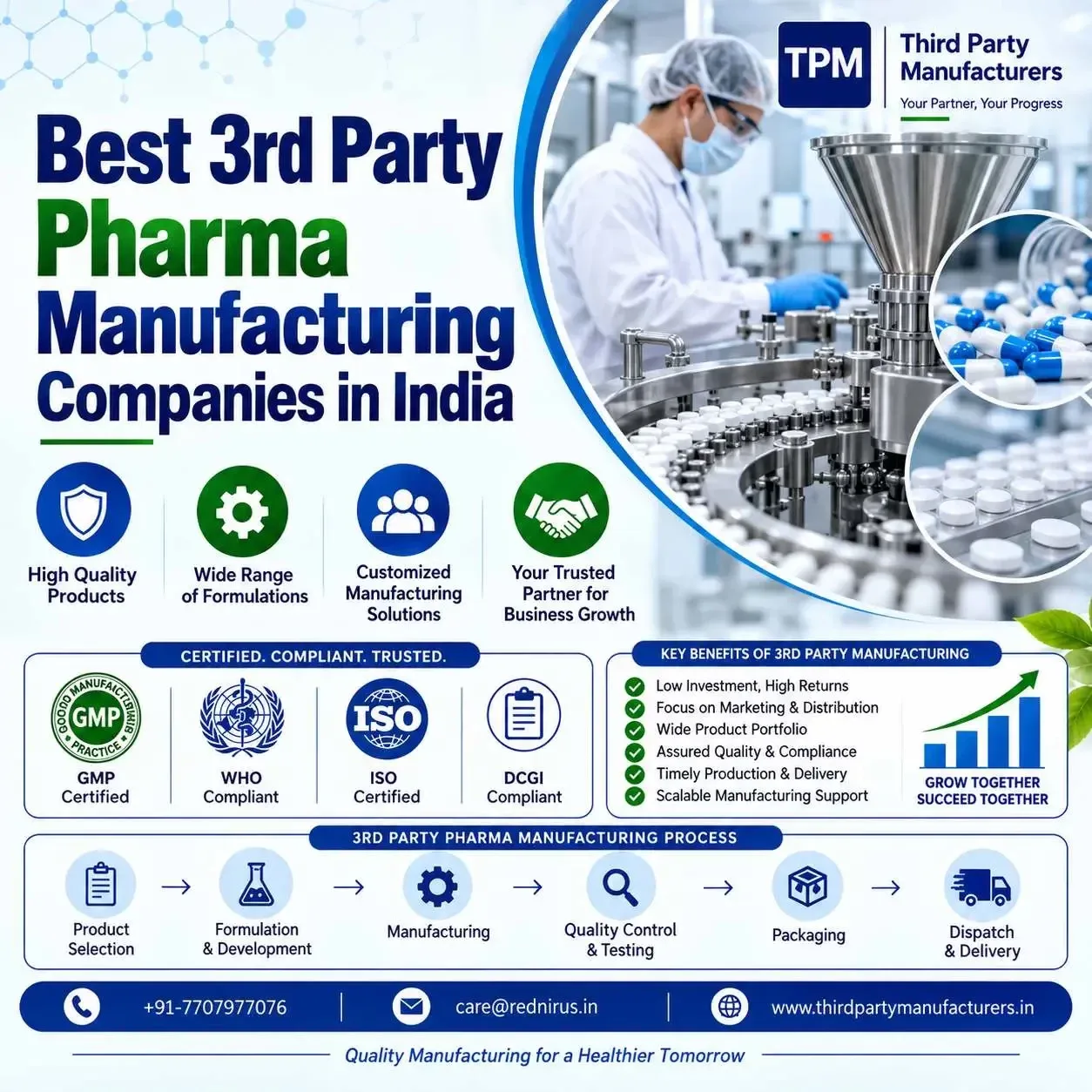
Making a choice among the 3rd Party Pharma Manufacturing Companies present in the Indian market at this time is probably the most crucial decision a pharma marketer, distributor, or franchisee will have to make, as the manufacturer you are going to collaborate with will determine the quality of your products and their shipping period and will have a huge influence on your brand’s image in the future. Indian third party manufacturing has become an essential part of the local and exporting pharma business, with thousands of WHO-GMP and ISO certified manufacturers producing tablets, capsules, injections, ointments and nutraceuticals. If you are running a PCD franchise business, a derma or veterinary brand, or if you are an Ayurvedic marketer or a critical care supplier, outsourcing to a proven manufacturer is an option for you that eliminates the need for big capital investments, but still gives you pharmaceutical medicines under your own label.
What are 3rd Party Pharma Manufacturing Companies?
Pharma Third Party Manufacturing Company is a licensed factory that produces medicines as per the needs of another company using that company's branding and packaging details. The marketing company provides the product range along with artwork, and sometimes preference in sourcing of raw materials while the manufacturing unit takes care of procurement of API and excipients along with production, quality checks, and packaging of finished goods. Such a system is known as Third Party Pharma Manufacturing or contract manufacturing or loan licensing based upon commercial and regulatory aspects of the agreement.
While manufacturing products internally requires investment in the plant, Third Party Manufacturing allows a company to increase their portfolio of pharma products without having any fixed assets. That is exactly the reason behind the increasing popularity of such a mode among PCD pharma franchise companies operating in Punjab, Himachal Pradesh, Gujarat, and similar other manufacturing-rich states.
How to Choose the Best 3rd Party Pharma Manufacturing Companies in India?
Finding the best 3rd Party Pharma Manufacturing Companies requires looking well beyond a low quoted rate per unit. A manufacturer's true value shows up in consistency: whether the same batch quality, packaging finish, and delivery schedule can be replicated across hundreds of repeat orders, not just the sample batch used to win your business.
A few practical filters help separate credible Third Party Manufacturers from the rest:
- Certifications of the plant: WHO-GMP, ISO 9001, US FDA/EU-GMP certification if applicable for export-focused units.
- Variety of products and dosage forms: tablets, capsules, dry syrups, injectables, creams and sachets, all available in a single unit cut down on having to deal with several vendors at the same time.
- Minimum Order Quantity (MOQ): small MOQs work well with new franchises; large, cost-conscious orders will work with established distributors.
- R&D capabilities: helpful when introducing an innovative product and not a me-too generic.
- Documentation support: Drug licence, CoPP (Certificate of Pharmaceutical Product), and stability data, which matter for both domestic marketing and export tenders.
- Turnaround time: A realistic production-to-dispatch timeline communicated upfront, rather than promised and missed.
Franchise owners evaluating a 3rd Party Manufacturer should also request sample packaging and a factory visit wherever feasible, since photographs on a website rarely reflect actual shop-floor discipline.
Pricing conversations deserve equal scrutiny. A quote that looks attractive on paper can hide costs that surface later — packaging revisions, minimum billing thresholds, or freight charges added after the order is confirmed. Asking for a complete cost breakdown and comparing at least two or three Third Party Manufacturing Pharma Companies before finalising, gives a franchise owner a realistic sense of market rates rather than relying on a single vendor's pitch.
Key Certifications and Compliance Pharma Third Party Manufacturing Company Must Have
Regulatory compliance is absolutely mandatory for 3rd Party Manufacturing of Pharmaceuticals and the sole criteria for differentiation between the company which you can trust for decades to come and the one that becomes a liability for your brand.
The basic criteria which a reputable unit engaged in 3rd Party Manufacturing of Pharmaceuticals must satisfy are:
- Manufacturing license under Schedule M of Drugs and Cosmetics Rules proving that the unit meets prescribed GMP criteria in terms of facilities, machinery and quality control.
- WHO-GMP license, which is fast becoming a basic prerequisite and not an added advantage in the Indian marketplace.
- A functioning in-house quality control and quality assurance (QC/QA) laboratory capable of raw material, in-process and finished-product testing.
- Proper documentation practices — batch manufacturing records, stability studies, and change-control logs that stand up to scrutiny during state drug inspections or client audits.
For businesses supplying government tenders, hospitals, or export markets, additional approvals such as CoPP or country specific registrations become essential. Skipping this diligence is the most common reason franchise businesses later face stock recalls or regulatory notices traced back to their manufacturing partner rather than their own operations.
Top Segments Served by Third Party Manufacturers in India
India's third party manufacturing pharma companies don't operate as a single undifferentiated category — most units specialise, and knowing where a manufacturer's real strength lies avoids mismatched partnerships.
- PCD and franchise pharma: General range tablets, capsules, and syrups for monopoly-based distribution models.
- Derma and cosmeceuticals: Creams, gels, and lotions requiring specialised mixing and filling lines.
- Veterinary formulations: A fast-growing niche with distinct regulatory pathways from human medicines.
- Ayurvedic and herbal products: Classical and proprietary formulations manufactured under AYUSH licensing rather than allopathic Schedule M.
- Critical care and injectables: The most compliance-intensive category, requiring sterile manufacturing environments and stringent batch documentation.
- Nutraceuticals and health supplements: A segment that has expanded rapidly alongside consumer wellness demand.
A manufacturer positioned as a best Medicine Third Party Manufacturing unit may still lack the specific licensing or equipment for injectables or Ayurvedic lines, so matching segment expertise to your product portfolio is essential before signing a manufacturing agreement.
It also helps to understand regional manufacturing clusters. Baddi and Paonta Sahib in Himachal Pradesh and Panchkula and Derabassi in the Punjab-Chandigarh zone contain a high number of formulation plants because of their previous excise benefits, and therefore many companies' PCD distribution network in India passes through this route. Another important region for this purpose includes Gujarat's Ahmedabad-Vadodara belt and some parts of Telangana. Sourcing from within these clusters can also reduce freight time for franchise businesses concentrated in North India, and it's one reason so much Pharma 3rd Party Manufacturing capacity remains concentrated in a handful of states rather than spread evenly across the country.
Benefits of Partnering with a 3rd Party Manufacturer in India
Working with an established 3rd Party Pharma Manufacturing partner offers more than just avoiding capital expenditure on a plant.
Faster market entry: A new brand can list products for sale within weeks rather than the years it takes to build and license an in-house facility.
Lower fixed costs: No investment in machinery, factory staff, or ongoing compliance overhead for the marketing company.
Access to specialised expertise: Established units bring formulation experience across dosage forms that a new entrant would take years to build independently.
Scalability: Order volumes can flex up or down with market demand without idle-capacity losses.
Focus on core strength: Franchise owners can concentrate resources on distribution, doctor visits, and brand building rather than production logistics.
These advantages explain why so many 3rd Party Pharmaceutical Companies operating as marketing-only entities have grown into recognised regional and national brands without ever owning a manufacturing unit themselves.
Another compounding advantage is easy to overlook: manufacturing partners that have run the same molecules for years build batch-level process knowledge—ideal mixing times, stability behaviour under Indian climatic storage conditions, and packaging materials that hold up during long-distance dispatch. A new brand benefits from this accumulated experience immediately, rather than learning it through its own trial-and-error production runs.
Pharmaceutical Third Party Manufacturing vs In-House Manufacturing
Choosing outsourcing over in-house depends on the considerations of capital investment, control, and time. While manufacturing in-house provides complete control over production scheduling, formulation and quality processes, it also requires substantial initial capital – capital for plant setup, equipment, licensing and labour. In third party manufacturing, all of this is handled by a licensed facility, thus shifting both production and regulatory responsibilities from the hands of small companies who may not have the ability to invest heavily in such things.
In PCD franchising, most of the companies begin with third party manufacturing. It is simply due to the fact that the company saves its huge fixed costs in terms of money and time, which can then be used for marketing and developing a sales network instead.
Red Flags to Avoid When Selecting Third Party Manufacturing Pharma Companies
Not every unit advertising itself among Third Party Manufacturing Companies delivers on its promises. A few warning signs are worth taking seriously before signing an agreement:
- Unrealistically low pricing that doesn't account for genuine raw material and compliance costs, often a sign of substandard inputs.
- Reluctance to share licence copies or GMP certificates when asked directly.
- No fixed turnaround commitment, or a history of missed delivery dates reported by existing clients.
- Packaging quality inconsistent with the sample shown during negotiation.
- No QC lab at their facility, meaning that each batch must go through testing done by an outside source.
One of the best methods to verify claims is talking to the other franchisees of the same manufacturing company where possible.
Frequently Asked Questions
Q1. Explain the difference between third party manufacturing and contract manufacturing?
These two terms are mostly synonymous in the Indian pharmaceutical business. It refers to a licensed manufacturer making products in the name of another company. However, there is a different legal concept known as loan licensing.
Q2. Is WHO-GMP Certification Mandatory for Third Party Manufacturer?
No, it is not a legal necessity in every country, but it has become a market standard practice. Most franchises and distributorships usually do not deal with manufacturers lacking such certification because of quality control reasons.
Q3. How much investment is needed to set up a PCD franchise with Third Party manufacturer?
Investment varies with the product range and geographical location, but when production is outsourced, the cost of starting a franchise becomes significantly cheaper as compared to having a manufacturing unit within the business premises.
Q4. Can a small pharma brand order low quantities from a third party manufacturer?
Yes. Many manufacturers offer flexible MOQs specifically to support new PCD franchise businesses, though minimums vary by dosage form and product complexity.
Q5. Do third party manufacturers provide export documentation support?
Established units with CoPP and international registrations typically do. Newer or smaller manufacturers may not, so this should be confirmed before finalising an export focused partnership.
Conclusion
The Indian pharmaceutical trade market is highly dependent upon the efficiency of the 3rd Party Pharmaceutical Manufacturers in India, and the dependence will further increase as more and more entrepreneurs opt for PCD franchise, derma, veterinary, ayurvedic and nutraceutical marketing without the need to construct a plant from scratch. If you have an ideal manufacturing partner for your business, then you are assured of good quality control, proper compliance, and reliable delivery, and thus assured that your brand gets all these benefits and much more. With the right manufacturer selected today, it will become the backbone of your brand operations tomorrow.
Must Read: Factors That Define the Best Oncology Products Manufacturers in India
What are 3rd Party Pharma Manufacturing Companies?
Pharma Third Party Manufacturing Company is a licensed factory that produces medicines as per the needs of another company using that company's branding and packaging details. Such a system is known as Third Party Pharma Manufacturing or contract manufacturing or loan licensing based upon commercial and regulatory aspects of the agreement.
Making a choice among the 3rd Party Pharma Manufacturing Companies present in the Indian market at this time is probably the most crucial decision a pharma marketer, distributor, or franchisee will have to make, as the manufacturer you are going to collaborate with will determine the quality of your products and their shipping period and will have a huge influence on your brand’s image in the future. Indian third party manufacturing has become an essential part of the local and exporting pharma business, with thousands of WHO-GMP and ISO certified manufacturers producing tablets, capsules, injections, ointments and nutraceuticals. If you are running a PCD franchise business, a derma or veter...
Key takeaways
- What are 3rd Party Pharma Manufacturing Companies?
- How to Choose the Best 3rd Party Pharma Manufacturing Companies in India?
- Key Certifications and Compliance Pharma Third Party Manufacturing Company Must Have
- Top Segments Served by Third Party Manufacturers in India
- Benefits of Partnering with a 3rd Party Manufacturer in India
- Pharmaceutical Third Party Manufacturing vs In-House Manufacturing
How to order Best 3rd Party Pharma Manufacturing Companies in India
- Define the product Fix the composition, dosage form, pack size, quantity and your brand name.
- Shortlist manufacturers Compare WHO-GMP certification, product permission, capacity and location.
- Compare quotations Ask for the per-unit rate, MOQ, lead time and packing material cost in writing.
- Approve artwork and sample Finalise label, carton and MRP, and approve the pre-production sample.
- Receive your batch Pay the agreed advance and receive goods with invoice and certificate of analysis.