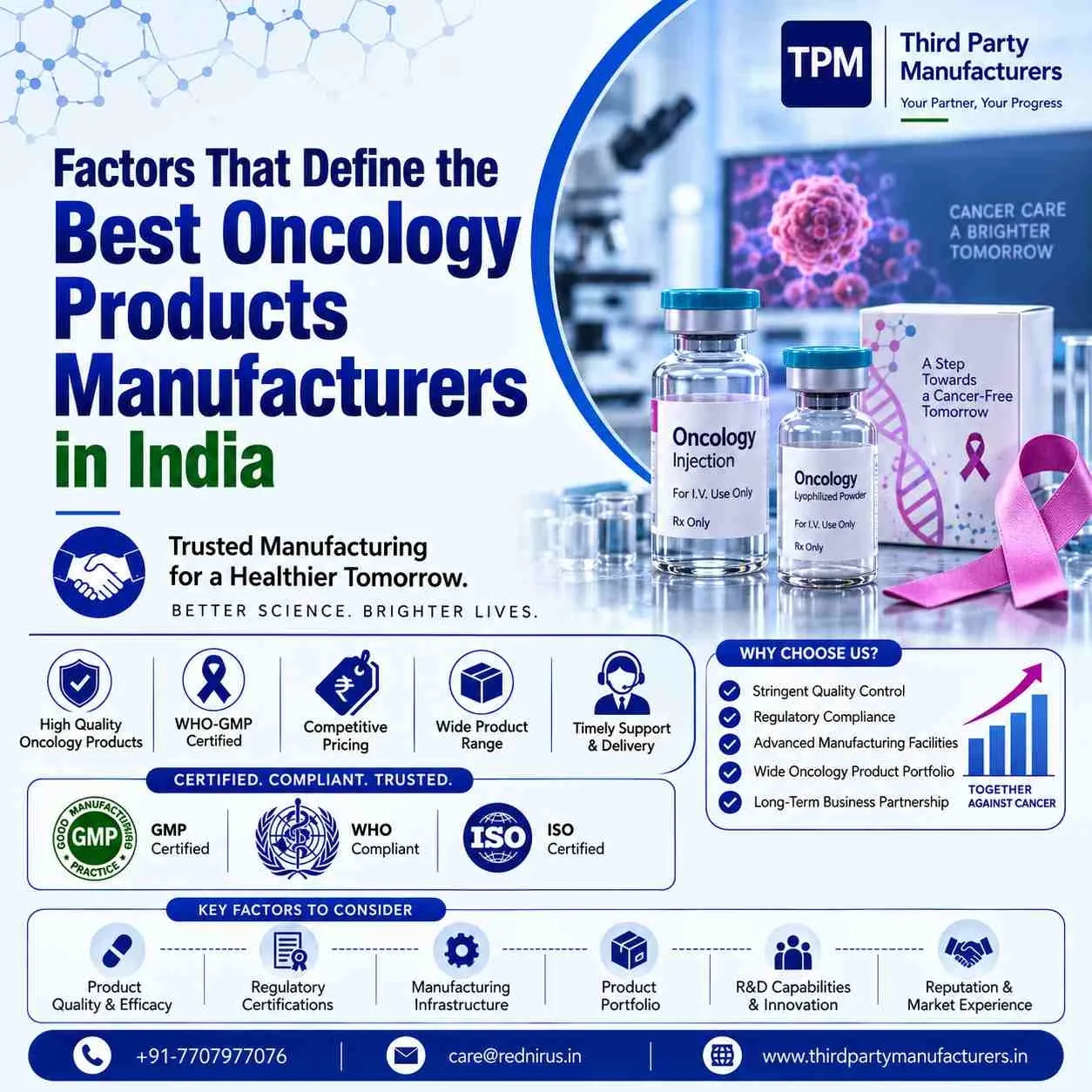
The factors that define the best Oncology Products Manufacturers in India include product quality, regulatory compliance, manufacturing standards, research capabilities, therapeutic range and supply reliability. Leading manufacturers typically follow Good Manufacturing Practices (GMP), maintain strict quality control, use validated processes and ensure consistent availability of oncology medicines.
Oncology Products Manufacturers in India play a critical role in shaping India’s growing image as a reliable provider of cost-effective and assured quality cancer medicines not only to Indian hospitals but to other parts of the world as well. The increase in cases of cancer in urban and semi-urban India has compelled these manufacturers to make considerable investments in their specialized infrastructure and technical manpower to effectively deal with the cytotoxic products used in making the medicines. Not all pharmaceutical plants can meet these requirements and hence, they cannot take up oncology manufacturing operations. For franchise partners, hospitals, distributors, and international buyers evaluating potential partners, understanding what genuinely separates a capable manufacturer from an average one is essential before signing any agreement or placing a bulk order.
Understanding What Sets Leading Oncology Products Manufacturers
At its core, the difference between an average unit and a genuinely reliable name among Oncology Products Manufacturers comes down to how seriously the company treats risk. Cancer medicines are unforgiving of shortcuts — a contamination event, a dosing error, or a stability failure can have consequences far more severe than with ordinary generics. And this is exactly why the best Oncology Pharma Companies base their whole operational system on containment, traceability, and documentation instead of considering this just another requirement that has to be checked off.
The top Oncology Pharmaceutical Companies also possess another company characteristic that they have in common; they spend as much on training people as on purchasing equipment. To handle cytotoxic and cytostatic substances, it is essential to have well-trained staff who know all the principles of dealing with air flow, personal protective clothing, and neutralization of waste. Buyers who visit a plant should look beyond the certificates on the wall and ask how frequently staff are retrained, how batch deviations are handled, and how the company responds when something goes wrong — because it eventually will and how a manufacturer reacts tells you more than any brochure.
There's also a growing expectation, especially among hospital procurement teams and franchise partners, that a manufacturer can explain its own processes clearly rather than hiding behind jargon. Transparency about batch records, source of active pharmaceutical ingredients, and testing methodology has become a practical filter for identifying which companies genuinely understand oncology manufacturing versus those that have simply added it to an existing generic product line without adapting their systems accordingly.
WHO-GMP Compliance and Regulatory Standing Among Cancer Pharmaceutical Companies?
Regulatory credibility is non-negotiable when it comes to Cancer Pharmaceutical Companies. WHO-GMP certification, approvals under Schedule M, and a valid Certificate of Pharmaceutical Product (CoPP) are baseline expectations, not differentiators — but the way a company maintains these approvals over time says a lot about its consistency. Some manufacturers treat audits as a one-time hurdle; the better ones build ongoing internal audit cycles that catch issues before an external inspector does.
For Oncology Pharmaceutical Companies supplying government tenders, hospital chains, or export markets, additional layers of scrutiny come into play — batch release testing, environmental monitoring records, and validated cleaning protocols between cytotoxic product changeovers. Franchise partners and distributors should specifically ask to see recent inspection outcomes rather than relying solely on a certificate's issue date, since regulatory standing can shift between renewal cycles depending on how a facility is actually run day to day.
Manufacturing Infrastructure and Quality Systems in Cancer Medicine Manufacturing
The manufacturing of oncology medicines is totally different from the production of regular injections or syrups. Most cancer medicine molecules are usually cytotoxic, which implies that they have a destructive effect on cells even if they come into contact with healthy cells, which is the reason why the best Cancer Medicine Manufacturers always have special segregated blocks with their own air-handling systems and not the same as other medicines.
Quality systems matter just as much as hardware. A genuine Third Party Manufacturers maintain robust change-control processes, validated cleaning-in-place procedures, and stability chambers that track products across real-time and accelerated conditions. This matters because oncology formulations — particularly injectables and lyophilized products — are sensitive to temperature excursions and handling errors during transit, not just during production. A manufacturer that can demonstrate rigorous in-house testing alongside transport validation data offers a materially safer proposition for anyone reselling or dispensing the product downstream.
Product Portfolio Strength Among Oncology Medicine Manufacturers and Oncology Drug Manufacturers
A broad, well-managed portfolio is one of the clearest signals of technical maturity. Established Oncology Medicine Manufacturers typically offer a mix of injectables, oral solid dosages, targeted therapy molecules, and increasingly, biosimilars — segments that each demand different formulation expertise and equipment. A company that only manufactures a narrow band of older, off-patent molecules may be technically competent but limited in how well it can serve a partner's long-term growth plans.
Equally important is how Oncology Drug Manufacturers manage their molecule pipeline. Cancer treatment protocols evolve quickly and manufacturers who track emerging therapeutic classes — hormonal therapies, monoclonal antibodies, targeted small molecules — tend to stay relevant to prescribers and hospital formularies for longer. It certainly helps franchisees and distributors in this regard since the capability of a manufacturer to launch new molecules keeping pace with the evolving standards of clinical practice often decides the commercial viability of a portfolio over the course of five to ten years of partnership.
The packaging and presentation aspects assume greater importance in oncology than other therapeutic areas. The integrity of vials, tamper-proof seals, ready-to-go packages suitable for cold chain transport of temperature sensitive injectable products, and clear labelling in multiple languages prevent mishandling during the process of shipment. If a manufacturer gives importance to such issues on the back end of the supply chain, then there is a good chance that he does the same on the front end of the supply chain as well.
Export Credentials and Global Reach of Anti Cancer Medicine Exporters
India's position as one of the world's leading suppliers of affordable cancer therapeutics rests heavily on the credibility of Anti Cancer Medicine Exporters. Markets across Africa, the CIS region, Southeast Asia, and Latin America depend on Indian-manufactured oncology products, and that trust is built on documentation — USFDA and EU-GMP approvals where applicable, product registration dossiers tailored to each destination country, and consistent batch-to-batch quality that survives long shipping routes and variable climate conditions.
Reliable Anti Cancer Products Manufacturers also maintain dedicated regulatory affairs teams capable of compiling country-specific registration files, since export requirements differ significantly between markets with strict pharmacovigilance frameworks and those with lighter-touch registration processes. A manufacturer that can navigate both efficiently, without cutting corners in either, demonstrates the kind of operational depth that smaller, exports-only players often lack.
Third Party and Contract Manufacturing Support for Franchise and Export Partners
A large share of India's oncology output moves through third-party arrangements, which makes this category worth examining separately. Anti Cancer Medicine Third Party Manufacturers basically extend their resources, certifications, and processes to their partnering brands, enabling franchisees and distributors to sell their cancer treatments without having their own manufacturing plant.
Good Anti Cancer Medicine Contract Manufacturers set themselves apart by providing proper documentation, setting practical deadlines for product production, and even assisting their clients with their regulatory forms. Anti Cancer Medicine 3rd Party Pharma Manufacturing done well involves more than filling orders — it includes batch-wise quality certificates, timely communication about supply constraints, and consistent packaging standards that protect the partner brand's reputation with hospitals and oncologists.
Similarly, Anti Cancer Medicine Third Party Manufacturing and Anti Cancer Products Manufacturing arrangements work best when both sides treat the relationship as a long-term partnership rather than a transactional order. It is important for partners to consider the responsiveness of a potential manufacturer at the inquiry level itself, as unresponsive communication prior to the signing of the contract does not improve after that point.
Commonly Asked Questions (FAQs)
Q1. Which credentials must be validated before embarking on an association with an oncology supplier?
Ensure that the supplier possesses at least WHO and GMP certification, CoPP and Schedule M certifications. When dealing with exports, ensure that the manufacturer has received USFDA and EU-GMP certifications where applicable to the export market.
Q2. Why is dedicated infrastructure crucial when producing cancer medicines?
Oncology products are always cytotoxic in nature, and hence the manufacturing units need to be separate from those used for other products. The use of common production lines with other medicines poses serious health and quality hazards.
Q3. How does outsourcing production help franchise operations?
It enables the franchise partner to utilize existing certifications and facilities without creating their own, thereby reducing investment while accessing the oncology market through their own label.
Conclusion
Selecting the right manufacturer from a range of Oncology Products Manufacturers is not always as easy as choosing between price sheets. Those manufacturers that deliver a consistent record of success view regulation adherence, containment systems, depth of product line, and export documentation as interrelated elements, rather than disconnected check boxes. Whether you are a franchise operator seeking a supplier partnership, a distribution company needing exportable products, or a hospital procurement team focused on quality control, your ultimate question remains the same: does the manufacturer show the discipline required for oncology products? Checking on infrastructure, regulation, and communications in advance would pay off big time.
Must Read: Best Syrup Manufacturing in India: Manufacturing Process, Benefits & Costs
What should you know about Factors That Define the Best Oncology Products Manufacturers in India?
The factors that define the best Oncology Products Manufacturers in India include product quality, regulatory compliance, manufacturing standards, research capabilities, therapeutic range and supply reliability. Leading manufacturers typically follow Good Manufacturing Practices (GMP), maintain strict quality control, use validated processes and ensure consistent availability of oncology medicines.
The factors that define the best Oncology Products Manufacturers in India include product quality, regulatory compliance, manufacturing standards, research capabilities, therapeutic range and supply reliability. Leading manufacturers typically follow Good Manufacturing Practices (GMP), maintain strict quality control, use validated processes and ensure consistent availability of oncology medicines. Oncology Products Manufacturers in India play a critical role in shaping India’s growing image as a reliable provider of cost-effective and assured quality cancer medicines not only to Indian hospitals but to other parts of the world as well. The increase in cases of cancer in urban and semi-urban...
Key takeaways
- Understanding What Sets Leading Oncology Products Manufacturers
- WHO-GMP Compliance and Regulatory Standing Among Cancer Pharmaceutical Companies
- Manufacturing Infrastructure and Quality Systems in Cancer Medicine Manufacturing
- Product Portfolio Strength Among Oncology Medicine Manufacturers and Oncology Drug Manufacturers
- Export Credentials and Global Reach of Anti Cancer Medicine Exporters
- Third Party and Contract Manufacturing Support for Franchise and Export Partners
By the numbers
- India is the largest provider of generic medicines globally — IBEF
- India has the highest number of US-FDA compliant manufacturing facilities outside the United States — Invest India, Government of India
How to order Factors That Define the Best Oncology Products Manufacturers in India
- Define the product Fix the composition, dosage form, pack size, quantity and your brand name.
- Shortlist manufacturers Compare WHO-GMP certification, product permission, capacity and location.
- Compare quotations Ask for the per-unit rate, MOQ, lead time and packing material cost in writing.
- Approve artwork and sample Finalise label, carton and MRP, and approve the pre-production sample.
- Receive your batch Pay the agreed advance and receive goods with invoice and certificate of analysis.