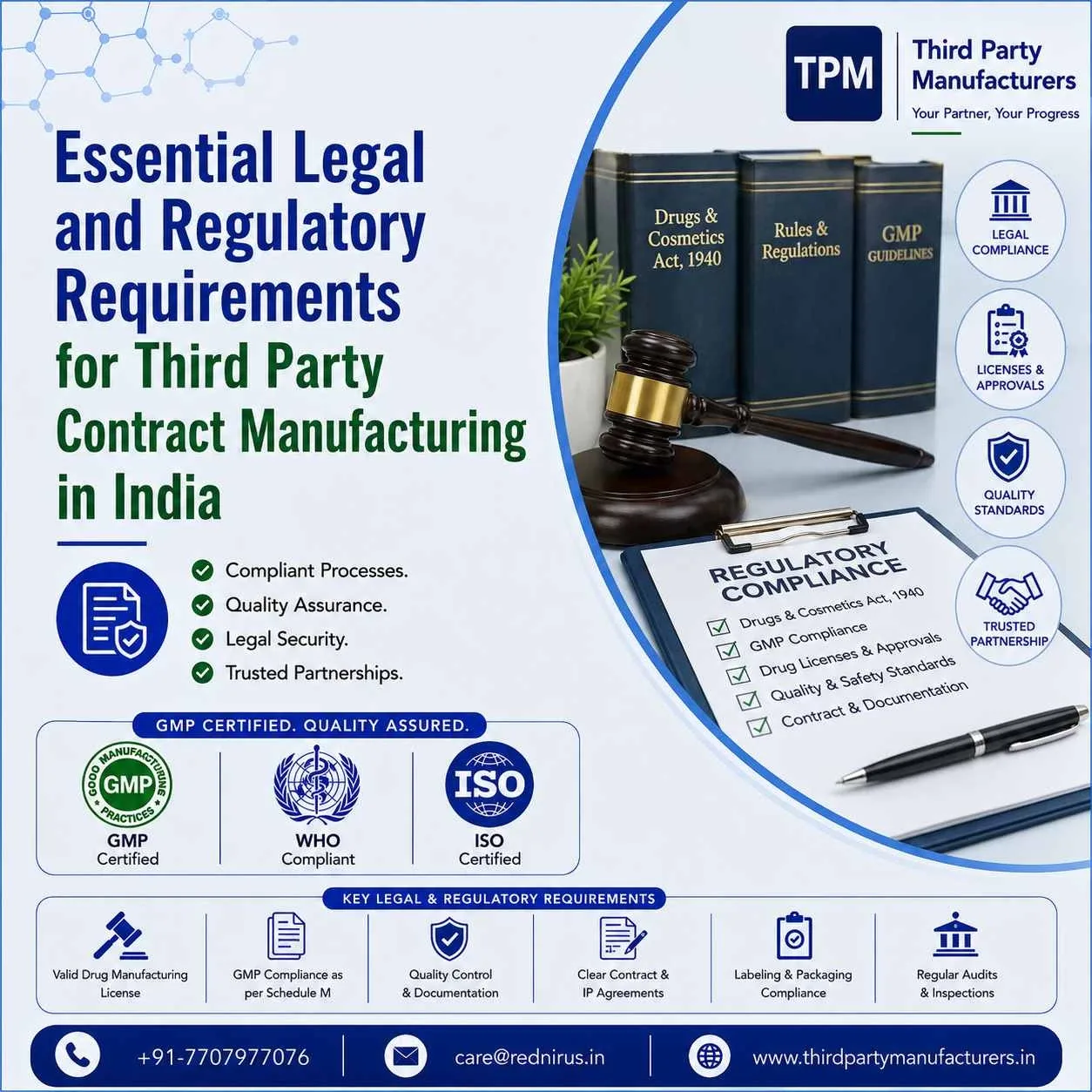
Essential Legal and Regulatory Requirements for Third Party Contract Manufacturing in India include obtaining valid manufacturing licenses, complying with Good Manufacturing Practices (GMP), meeting CDSCO and Drugs and Cosmetics Act regulations, maintaining quality documentation and following labeling and safety standards. These requirements help ensure legal compliance, product quallabellingity and regulatory approval.
Third Party Contract Manufacturing has emerged as one of the fastest growing business models in the pharmaceutical industry in India, which makes it possible for brand owners to manufacture their products without having to set up any manufacturing plant. With rising demands from Tier 2 and Tier 3 cities, many entrepreneurs are opting for Pharma Contract Manufacturing as a low investment approach to enter the market with their very own product range, through a trusted brand. But such a business model is viable only if both parties involved have a clear understanding of its legal structure. Pharmaceutical Contract Manufacturing in India is subject to stringent laws dealing with license, quality, labelling, and contract terms. This blog highlights the various legal requirements that are imperative for any brand owner or manufacturer before engaging in a Third Party Manufacturing in India.
What is Third Party Contract Manufacturing?
Before proceeding to discuss the compliance issues, it would be essential to know about the arrangement itself. In plain language, the brand owner cooperates with an experienced 3rd Party Manufacturer Company in the Pharma industry to manufacture medications on behalf of the brand owner using the formula and packaging and brand name owned by the brand owner. All manufacturing operations and packing and testing procedures are made by the manufacturer; the brand owner is responsible for the marketing and selling of the produced medicines.
This is not a loan license agreement where the brand owner owns its own manufacturing license, but utilizes the facilities of another company. In 3rd Party Pharma Manufacturing, all responsibilities in terms of the manufacturing and regulatory compliance of the pharmaceutical plant belong to the manufacturer, whereas the brand owner is responsible for the quality claims and market compliance.
The brand owners generally opt for this mode for tablets, capsules, syrup, injectables, ointment, and Ayurvedic products since it eliminates the requirement of large investments in terms of plant & machinery. Rather than investing crores in establishing the unit, the newcomer can come out with dozens of SKUs within a few weeks by collaborating with an existing and duly licensed manufacturer. The model is particularly appealing to PCD Pharma franchise operations and distributors venturing into Tier 2 & Tier 3 cities.
Key Licenses and Legal Requirements for Pharma Contract Manufacturing Companies
Every genuine business collaboration in the industry requires proper licensing. Partnering with an unregistered or improperly registered Contract Manufacturing Company is perhaps the most serious legal challenge that a brand owner can face.
Pharma Products Manufacturing License under Schedule M
Every Pharmaceutical Contract Manufacturing Company must have a valid manufacturing license according to the provisions of the Drugs and Cosmetics Act, 1940 and Schedule M regulations concerning plant layout, equipment, documentation, and quality control system. The brand owner must always ensure that the manufacturing company has a valid license.
Registration under GST and Trademark Registration
Apart from having valid GST registration for tax purposes and documentation for the billing process from the manufacturer to the brand owner, the Third Party Medicine Manufacturer should have proper trademark registration of the medicine brand name and its logo to protect the company from imitation after launching the product in the market.
Labelling & Packaging
The labels for products manufactured through this arrangement must be compliant with the Drugs & Cosmetics Rules, which require details such as the license number of manufacture, batch number, date of manufacture, expiry date, composition, names of manufacturer and marketing company to be present. Non-compliance or omission in labelling is one of the most frequent causes of rejection of products in regulatory inspections. Hence, both parties should be satisfied with artwork before production is undertaken.
Quality Certifications Required by Pharmaceutical Contract Manufacturing Companies
Licensing alone is not enough. Quality certifications indicate whether a manufacturer follows internationally accepted production and testing standards.
Certification for WHO-GMP and ISO Compliance
Most of the well-known Contract Manufacturing Companies today possess WHO-GMP (Good Manufacturing Practices) certification, which is proof that the company has been certified based on hygiene, calibration of equipment and documentation standards of production worldwide. ISO certification adds value to this by ensuring consistency in the Quality Management System of production batch after batch.
Certificate of Pharmaceutical Product (CoPP)
It is important for companies that wish to export or sell to tendered governments that they obtain the Certificate of Pharmaceutical Product that is given by the Drug Authority. This certificate acts as proof of manufacturing and marketing of products according to Indian regulations, and it is usually required by overseas companies before importing 3rd Party Manufacturing Pharmaceuticals from India. For the brand owners who plan to expand their business to other countries, it is advised to find out earlier if the manufacturer has any active CoPPs for the formulation.
Legal Agreement and Compliance Checklist before Partnership
A carefully drafted agreement not only helps the brand owner but also helps the manufacturer in the future to avoid any legal issues. Both parties need to make sure that the contract covers the following before forming a partnership with third party manufacturing companies:
- Formulation and packaging rights and intellectual property rights
- Minimum order quantity and prices
- Quality control responsibilities and batch testing protocols
- Recall procedures and liability in case of product defects
- Confidentiality clauses to protect proprietary formulations
- Termination conditions and dispute resolution mechanisms
If you neglect to cover any of these areas, you could be putting yourself at great risk legally, particularly if there is some kind of complaint about quality after the product has been released into the marketplace.
There are many small brand owners who still depend upon verbal agreement or an informal purchase order in dealings with their Contract Manufacturing Company partners, thinking that trust is all that is needed. Unfortunately, this strategy can put you at considerable risk, because regulatory agencies, courts, and even banks will need a written agreement for any licensing issues, GST audit, or dispute resolution.
How to Identify Top Pharma Contract Manufacturing Companies in India?
With thousands of manufacturers offering third party manufacturing services, due diligence is critical before signing any agreement. Brand owners looking to work with genuine, compliant manufacturers should check the following:
Physical verification of the manufacturing site and license validity with the State Drug Authority
- Availability of WHO-GMP, ISO, and CoPP documentation
- Track record with other brand owners and product portfolio range
- Transparency in raw material sourcing and batch documentation
- Willingness to share sample agreements and quality assurance reports
Selecting Top Pharma Contract Manufacturing Companies requires effort; however, this careful process avoids problems with licensing in the future and ensures that no mistakes will be made, particularly by those who are just entering this market niche and need to establish PCD or franchise businesses.
There are some red flags that need to be heeded, including companies' refusal to disclose the number of their drug licenses, unwillingness to allow facility inspections, unusually low prices compared to the industry average, or inability to specify batch test procedures. Honest and legal manufacturing companies usually have nothing to hide.
Frequently Asked Questions
Q1: Is a manufacturing license required for the brand owner in case of third party manufacturing?
Ans: No, in case of pure third party manufacturing, the manufacturing license will be with the manufacturer. However, the brand owner will have to make sure that they have registered their trademark and received necessary approval for marketing the same.
Q2: Which certifications should I look for while deciding on a manufacturer?
Ans: One must always check for WHO-GMP certificate, Schedule M manufacturing license, and Certificate of Pharmaceutical Product, where applicable. This ensures that the manufacturer meets the quality and safety criteria.
Q3: Can there be early termination of the contract between the brand owner and the third party manufacturer?
Ans: Yes, if the agreement mentions the terms of early termination, including notice period, completion of remaining orders, and disposal of unutilized packaging materials. Without that, early termination may result in problems.
Conclusion
Third Party Contract Manufacturing is a feasible way of accessing India’s pharmaceutical sector but only where such ventures are established based on adherence to law. By ensuring that there is verification of licenses and WHO and GMP certification as well as preparing a sound contract of manufacture, one can be sure that all these activities will protect their interests in the future. In either case whether you are looking to find out about a Pharma Third Party Manufacturing Company for the first time or scale up an existing franchise network, the best approach will always be compliance over taking any shortcuts. Make sure that you take all the necessary measures in verification of licenses, certifications, and agreements in order to establish yourself in business legally and profitably.
In this regard, the competition among Contract Manufacturing Companies will see those who take time to ensure legal due diligence and agreements gaining a competitive advantage in terms of growth and avoidance of regulatory issues.
Must Read: Private Label Pharma Tablet Manufacturing in India: Benefits & Process
What is Third Party Contract Manufacturing?
Before proceeding to discuss the compliance issues, it would be essential to know about the arrangement itself. In plain language, the brand owner cooperates with an experienced 3rd Party Manufacturer Company in the Pharma industry to manufacture medications on behalf of the brand owner using the formula and packaging and brand name owned by the brand owner.
Essential Legal and Regulatory Requirements for Third Party Contract Manufacturing in India include obtaining valid manufacturing licenses, complying with Good Manufacturing Practices (GMP), meeting CDSCO and Drugs and Cosmetics Act regulations, maintaining quality documentation and following labeling and safety standards. These requirements help ensure legal compliance, product quallabellingity and regulatory approval. Third Party Contract Manufacturing has emerged as one of the fastest growing business models in the pharmaceutical industry in India, which makes it possible for brand owners to manufacture their products without having to set up any manufacturing plant. With rising demands f...
Key takeaways
- What is Third Party Contract Manufacturing?
- Key Licenses and Legal Requirements for Pharma Contract Manufacturing Companies
- Quality Certifications Required by Pharmaceutical Contract Manufacturing Companies
- Legal Agreement and Compliance Checklist before Partnership
- How to Identify Top Pharma Contract Manufacturing Companies in India?
How to order Regulatory Requirements for Third Party Contract Manufacturing
- Define the product Fix the composition, dosage form, pack size, quantity and your brand name.
- Shortlist manufacturers Compare WHO-GMP certification, product permission, capacity and location.
- Compare quotations Ask for the per-unit rate, MOQ, lead time and packing material cost in writing.
- Approve artwork and sample Finalise label, carton and MRP, and approve the pre-production sample.
- Receive your batch Pay the agreed advance and receive goods with invoice and certificate of analysis.