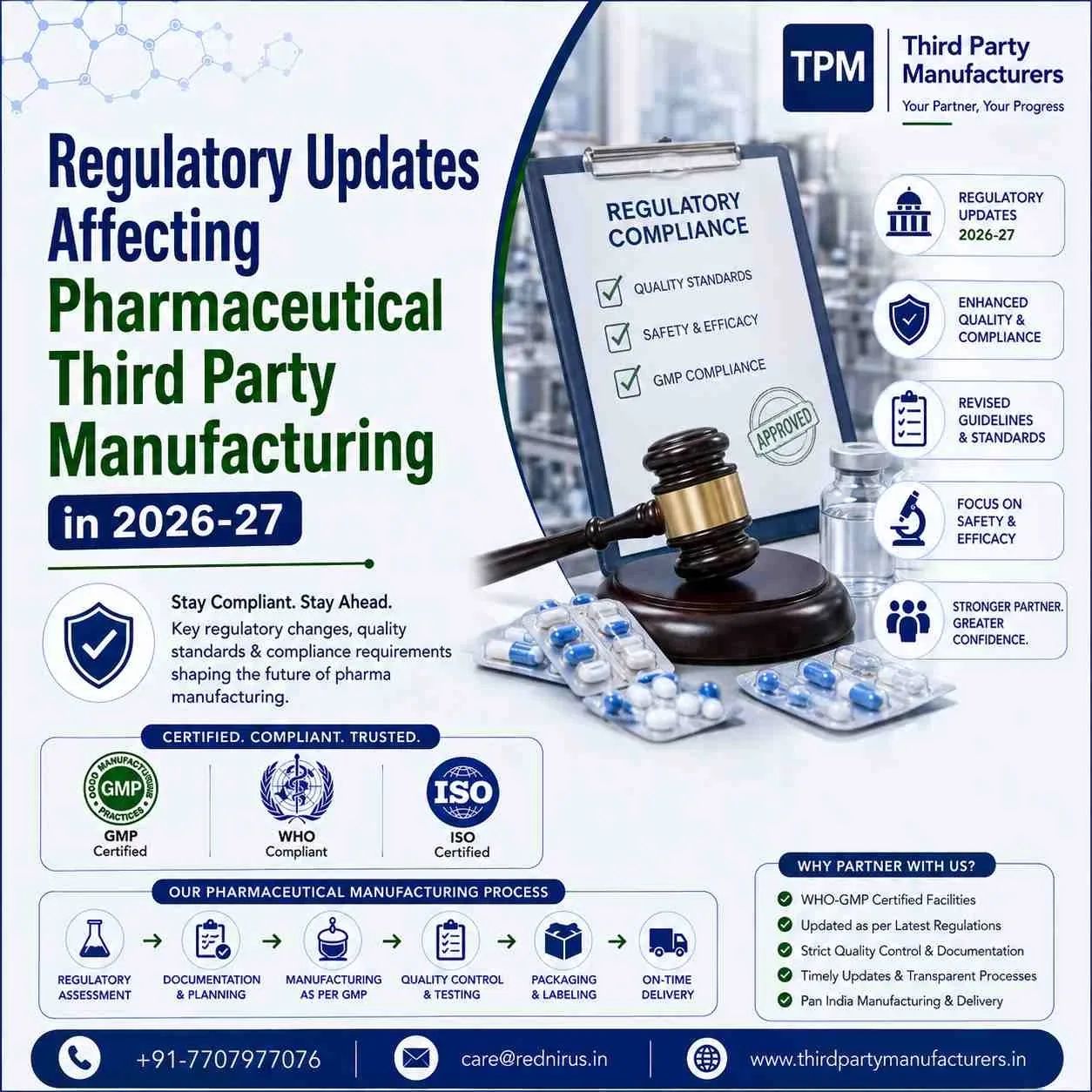
Regulatory Updates Affecting Pharmaceutical Third Party Manufacturing in 2026-27 include stricter compliance, quality control, documentation, manufacturing standards, and regulatory oversight. Companies must follow updated requirements for product quality, licensing, labelling, testing and Good Manufacturing Practices (GMP) to maintain compliance and ensure safe, consistent pharmaceutical production.
The time has come for Pharmaceutical Third Party Manufacturing to see an era of stringent regulations as India implements changes in regulations concerning drugs, facilities and documentation. The last few years have seen significant changes being made with regard to regulations in the field of loan licensing and outsourcing and the coming years, that is 2026-27, will see a new era of collaboration between the third party manufacturers, brand owners and the distributors. Beginning with the change in Schedule M, passing through licensing and traceability regulations, every stakeholder operating in the field of outsourcing needs to know about the changes that are happening. If you are running a pharma marketing company that outsources its manufacturing process, or you are a manufacturer working for another company, knowing about these regulatory changes is very important.
What Pharmaceutical Third Party Manufacturing Mean in Today's Regulatory Climate?
Third Party Pharmaceutical Manufacturing means hiring a license production facility that will produce medicines for a brand owner using its own brand name. This business model is what helped India's pharmaceutical franchising and PCD sectors flourish for many years because it allows companies focused on marketing to enter markets without spending crores to develop their own manufacturing facility. The Pharma Third Party Manufacturing Company should have all the required licenses and GMP certifications along with equipment, while the brand owner will take care of sales and marketing.
What has changed in the current year of 2026-27 is the degree of responsibility being laid down by regulators from both sides. The brand owners are not considered to be passive participants anymore. It becomes imperative for them to ensure that their Third Party Manufacturers have all the valid licenses and operate according to Schedule M compliance standards and maintain batch records too.
Key Regulatory Changes Affecting Third Party Pharma Manufacturing Companies
Revised Schedule M and Plant Upgrades
With the implementation of revised Schedule M norms in a phased manner, Third Party Manufacturing Companies are required to improve their infrastructure with improved ventilation systems, validated equipment, computer-based documentation, and a quality control lab. Small units with a history of working under lenient norms will be forced to either upgrade their facilities or lose their manufacturing license. This is already seen as a trend as some 3rd Party Manufacturing Companies have merged their units or shut down those units which failed to maintain the benchmark.
Licensing & State Inspections
There has been an increase in inspections of manufacturing units by state drug authorities. The 3rd Party Manufacturer will be suspended for production if found without updated documentation, expired certification, or poor storage conditions. For the brands, the record of the manufacturer is very important as it impacts the market reputation of their products.
Digital Traceability and Barcoding Norms
Track-and-trace requirements are expanding beyond export-only formulations to cover a wider range of domestic products. Third party manufacturing products now increasingly require QR codes or barcodes linked to batch data, so that distributors and even end consumers can verify authenticity. This is aimed at curbing counterfeit medicines, but it also adds a layer of compliance cost that both manufacturers and brand owners need to budget for.
Quality Standards Every Third Party Manufacturing Pharma Company Must Meet
There have been many raised quality standards for Pharma Contract Manufacturing and Pharmaceutical Contract Manufacturing. A unit needs to maintain its relevancy as a Third Party Pharma Manufacturing Company by following WHO-GMP guidelines, validated raw material procurement, and correct stability testing of all batches manufactured. There has been an increased focus on handling deviations, recall processes, and change control documentation in contract manufacturing companies because previous compliance failures used to be caused by these factors.
A lot of big companies in the market are upgrading themselves by automating the process. This is gradually raising the entry barrier for new 3rd Party Pharma Manufacturing Companies, but it is also building a more trustworthy ecosystem for brand owners who depend entirely on outsourced production.
How to Identify the Best Third Party Manufacturing Companies in India?
With regulatory expectations rising, choosing the Best Third Party Manufacturing Companies in India is no longer just about price per unit. Brand owners should look for units that are transparent about their licensing status, willing to share recent inspection reports, and equipped with modern manufacturing lines. The Best Third Party Pharma Manufacturers in India are typically those who have already adapted to the revised Schedule M framework and can show a clean compliance history over the past few audit cycles.
Several useful tests that need to be done before finalizing the contract are:
- Ensuring that the products manufacturing license and GMP certificates are valid and correspond to the goods being outsourced
- Organizing a plant visit for inspecting the storage, testing, and packaging facilities
- Investigating previous client references and verifying whether there have been any recalls or regulatory warnings about their products.
- Clarifying documentation support for state and central drug authority inspections
Following this kind of checklist helps brand owners avoid last-minute production halts caused by a partner's non-compliance, which can be far more damaging than a slightly higher manufacturing cost.
Growth Outlook for top Third Party Pharma Manufacturers in India
Despite the tighter compliance environment, demand for Third Party Manufacturing Pharma Companies is not slowing down. In fact, many analysts expect the market to grow further because established, compliant units are becoming more attractive to brand owners who want to avoid regulatory risk. The companies looking for 3rd Party Manufacturer are now tending to choose companies based in pharma-manufacturing clusters like Baddi, Panchkula, Ahmedabad, and Hyderabad, which have seen upgrading of their infrastructure to comply with the newer standards.
3rd Party Manufacturing Pharmaceuticals is now venturing into newer segments of therapeutics such as nutraceuticals, dermatology, and speciality injectables as companies seek diversity without having to take any manufacturing risks themselves. It is an interesting time for 2026-27 for those who want to do something different and distinguish themselves by being compliant.
Frequently Asked Questions
Q1. Do all Third Party Manufacturers need to comply with the revised Schedule M norms?
Yes, the revised Schedule M norms apply to all licensed manufacturing units, including those working under loan licensing or third party arrangements, regardless of their production scale or location within India.
Q2. How will the brand owner ascertain the compliance status of the manufacturing company?
The brand owner can ask for copies of existing licenses, GMP certification, and inspection reports; alternatively, the brand owner may confirm the validity of the licenses from the concerned State Drug Control Department.
Q3. Would these regulations have any cost implications on the cost of doing business in Pharma Contract Manufacturing?
Cost would rise to an extent; however, the reduced risks of recalls, disruption in production, and enhanced brand value would make up for it.
Conclusion
The regulations around Pharmaceutical Third Party Manufacturing in 2026-27 will make it imperative that the whole sector become more responsible and documented about manufacturing procedures. The implications of this shift in regulations on brand owners would be that partner choice would become just as important as product strategy for them. For manufacturers, the ability to keep track of changing Schedule M norms, inspections, and traceability norms would become mandatory. The companies that recognize this shift not as a hindrance to their work but as an opportunity to build trust are the ones that would rule India's third party pharma manufacturing sector in the coming years.
Must Read: Private Label Skin Care Manufacturers in India: MOQ, Pricing & Packaging Guide
What Pharmaceutical Third Party Manufacturing Mean in Today's Regulatory Climate?
Third Party Pharmaceutical Manufacturing means hiring a license production facility that will produce medicines for a brand owner using its own brand name. This business model is what helped India's pharmaceutical franchising and PCD sectors flourish for many years because it allows companies focused on marketing to enter markets without spending crores to develop their own manufacturing facility.
Regulatory Updates Affecting Pharmaceutical Third Party Manufacturing in 2026-27 include stricter compliance, quality control, documentation, manufacturing standards, and regulatory oversight. Companies must follow updated requirements for product quality, licensing, labelling, testing and Good Manufacturing Practices (GMP) to maintain compliance and ensure safe, consistent pharmaceutical production. The time has come for Pharmaceutical Third Party Manufacturing to see an era of stringent regulations as India implements changes in regulations concerning drugs, facilities and documentation. The last few years have seen significant changes being made with regard to regulations in the field of...
Key takeaways
- What Pharmaceutical Third Party Manufacturing Mean in Today's Regulatory Climate?
- Key Regulatory Changes Affecting Third Party Pharma Manufacturing Companies
- Revised Schedule M and Plant Upgrades
- Licensing & State Inspections
- Digital Traceability and Barcoding Norms
- Quality Standards Every Third Party Manufacturing Pharma Company Must Meet
How to order Regulatory Updates Affecting Pharmaceutical Third Party Manufacturing in 2026-27
- Define the product Fix the composition, dosage form, pack size, quantity and your brand name.
- Shortlist manufacturers Compare WHO-GMP certification, product permission, capacity and location.
- Compare quotations Ask for the per-unit rate, MOQ, lead time and packing material cost in writing.
- Approve artwork and sample Finalise label, carton and MRP, and approve the pre-production sample.
- Receive your batch Pay the agreed advance and receive goods with invoice and certificate of analysis.