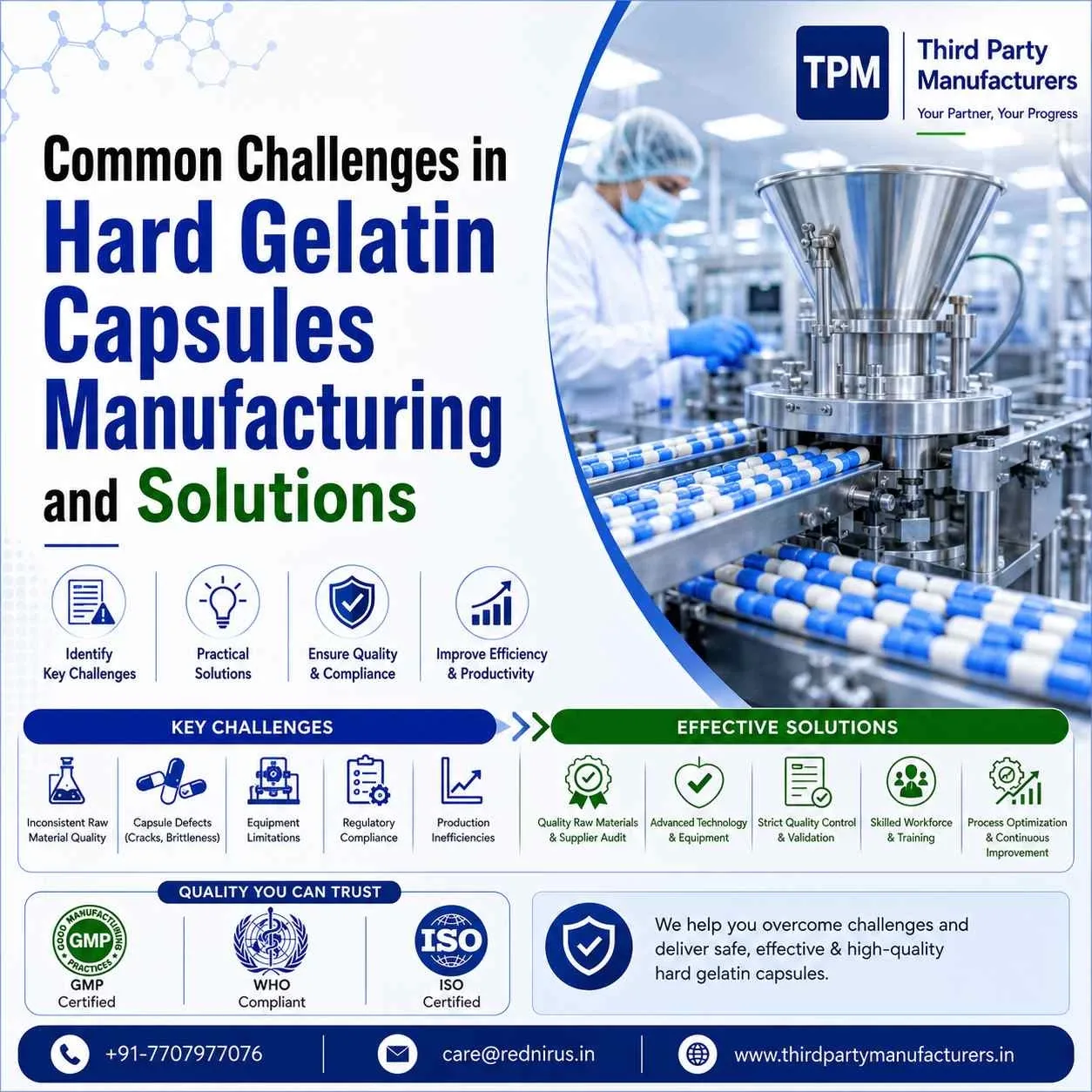
Hard gelatin capsule manufacturing can face challenges such as filling inaccuracies, capsule breakage, moisture imbalance, and sealing defects. These issues are reduced through quality raw materials, controlled production conditions, regular equipment maintenance and strict quality checks, ensuring consistent capsule performance, product safety and reliable pharmaceutical manufacturing.
Hard Gelatin Capsules Manufacturing is one of the most popular methods in the pharmaceutical sector due to its high accuracy in dosing, masking of bad taste and protection from moisture and sunlight for active ingredients. With increasing demand for oral solid dosage forms in India and other markets around the world, pharmaceutical companies and manufacturers of hard gelatin capsules come under more pressure concerning consistency, quality, and compliance. But the process of Manufacturing of Hard Gelatin Capsules has its drawbacks. The entire manufacturing process of Hard Gelatin Capsules is exposed to various risks. In this blog, we will discuss the most widespread problems that arise during the production of hard gelatin capsules and their solutions.
What is Hard Gelatin Capsules Manufacturing and Why Does It Matter?
Manufacture of Hard Gelatin Capsules consists of manufacturing two part hard capsule shells mainly composed of gelatin, water and colours, which later get filled with powders, granules, and pellets with Active Pharmaceutical Ingredients. Compared to tablets, capsules ensure quick disintegration, higher bioavailability, and easier swallowing by patients. As for Capsule Manufacturers, they have to use special machines in order to manufacture the shells of even thickness, size, and strength that will then be filled and sealed according to certain conditions. The process of dip-moulding, drying and joining should be coordinated in order to manufacture shells that correspond to Pharmacopoeia norms for weight, hardness, and dissolution.
It is important to know about the process since it is vital for product stability, shelf-life and the safety of the patients. The deviation of any factor such as humidity, temperature, or raw materials quality during the process of Hard Gelatin Capsule Manufacture may ruin the end product. That is why it is necessary for Pharmaceutical Capsules Manufacturers to detect the issues and deal with them at the beginning stage of the process in order to avoid losses and rejections.
Key Challenges Faced in Hard Gelatin Capsule Production
1. Raw Material Variability
Quality gelatins of differing blosom, viscosity, and moisture content are available from different suppliers and batches. This results in issues regarding thickness and solubility properties, thereby influencing the quality of capsules produced by Capsule Manufacturing Companies. Even small differences between suppliers result in brittle shells and an inability to pass disintegration tests. The seasonality of raw materials (hide and bones with collagen) for producing gelatin can also cause difficulties for Capsule Manufacturing Companies, especially for small producers who do not have long-term supply agreements with their suppliers.
2. Sensitivity to Moisture and Temperature Changes
The hard gelatin shells have high sensitivity to environmental factors. High humidity leads to sticky and soft shells, while low humidity results in brittleness of the shells and their tendency to cracking. Maintaining a relatively narrow band of humidity from 35 to 45% RH is a permanent problem for gelatin capsule manufacturers without modern HVAC systems. For regions with highly seasonal changes in humidity, such as most part of India during monsoons, this is an especially challenging task.
3. Capsule Filling Weight Variation
Uniform fill weight in millions of capsules being produced each hour continues to be one of the main challenges of Medicine Capsule Manufacturing. Unreliable powder discharge, poor granulation quality, or incorrect machine setup may lead to insufficiently or overly filled capsules affecting the correct dosage.
4. The Dangers of Cross-Contamination
For manufacturing plants that produce several types of products, including those involved in Capsule Contract Manufacturing, there is a greater danger of cross-contamination. This means that without proper cleaning validation, there will be a transfer of allergens or active ingredients from one product to another.
5. Brittleness and Cracking of Shells
Capsules that become too dry tend to crack during transportation and storage. This problem is usually cited by Pharma Capsule Manufacturer employees, especially when it comes to transportation to areas where there are drastic climatic differences.
6. Regulatory and Compliance Pressures
Compliance with the WHO-GMP, Schedule M and DCGI guidelines is yet another challenge. Capsules Manufacturers have to maintain proper documentation, process validations, and traceability at all levels, which may sometimes cause delays in production processes if not well integrated. The need for regular updates in the regulations requires that Pharma Capsule Manufacturer companies keep their staff up-to-date about the latest changes in order to ensure compliance.
7. Machine Downtime and Maintenance Problems
The high-speed capsule encapsulating machines work round the clock and any machine breakdown arising out of broken dies, pin misalignment, or electrical problems can be disruptive for the Capsule Manufacturing Companies. Such an unpredicted machine breakdown is highly disruptive for Capsule Manufacturing Companies working under tight deadlines.
Proven Solutions to Overcome Hard Gelatin Capsules Manufacturing Challenges
Standardizing Raw Material Sourcing
Using pre-qualified WHO-GMP certified gelatin manufacturers and carrying out quality tests on the gelatin batches for bloom and viscosity enables Hard Gelatin Capsule Production units to cut down batch variability greatly.
Climate Controlled Facilities Investments
Current Encapsulation Manufacturers have incorporated automated humidity and temperature control within the encapsulation areas. Maintaining consistent environmental conditions throughout the Production of Hard Gelatin Capsule process minimizes shell defects and improves yield.
Upgrading Filling Machinery and Calibration Protocols
Regular calibration of dosing pumps and auger-fill machines, combined with in-process weight checks every fifteen to twenty minutes, helps Medicine Capsule Manufacturing units maintain fill weight accuracy within acceptable limits.
Implementing Strict Cleaning Validation
For facilities offering Capsule Contract Manufacturing, dedicated production lines for high-risk products, along with validated cleaning-in-place procedures, effectively eliminate cross-contamination risks between different client batches.
Enhancing Packaging and Storage Procedures
The application of aluminium blister packaging with desiccants and regulating humidity in warehouses will assist in minimizing brittleness in shells for Pharmaceutical Capsule Manufacturers during storage and long-distance transportation.
E-Batch Recordkeeping
The use of e-batch manufacturing records and automatic quality management systems is going to be instrumental in helping Pharma Capsule Manufacturing companies remain audit ready without having any documentation errors.
Implementation of Preventive Maintenance Plans
The inspection of dies, pins, and vacuum equipment at regular intervals, as well as the availability of spare parts, would ensure that Capsule Manufacturing Companies do not suffer from any unplanned downtime.
Why Softgel and Soft Gelatin Capsule Manufacturers Share the Same Challenges?
Although this post talks mainly about hard capsules, it is important to mention that manufacturers of softgel capsules and every manufacturer of soft gelatin capsules are faced with similar problems related to gelatin quality, humidity management, and accurate filling. In addition to that, the manufacturer of soft gelatin capsules should deal with the encapsulation of liquid or semiliquid content. The Production of Soft Gelatin Capsule shares many quality control principles with hard shell production, including strict environmental monitoring and raw material standardization.
Today, many companies providing services for Soft Gel Capsule Contract Manufacturing have developed dual quality programs catering to both hard and soft capsule operations, thus making it possible for a Softgel Manufacturer to work with different pharmaceutical and nutraceutical customers within one GMP-approved facility.
For new pharmaceutical brands, an assessment of the candidate manufacturer's experience in producing both dosage forms could be a good criterion to evaluate their manufacturing capabilities. Indeed, it's likely that the Soft Gelatin Capsule Manufacturer, who also operates with hard shell capsules has developed more advanced quality processes because of the need for more thorough collaboration between different departments.
FAQs
Q1: What is the major problem faced by Hard Gelatin Capsules Manufacturing process?
Ans: Control of humidity has been the major problem, as the gelatin capsule shell is very susceptible to moisture changes. It may affect its physical properties such as cracking, weakening, and dissolving the capsule during production.
Q2: What can Capsule Manufacturing Companies do to avoid variation in fill weight?
Ans: Machine calibration, standardization of granule size, and regular weight measurements during the manufacturing process are the solutions. Additionally, automated filling equipment that measures fill weight can be used.
Q3: Are Capsule Manufacturing Companies safe from cross-contamination?
Ans: Yes, in cases where manufacturers adopt validated cleaning processes, dedicated equipment for certain products, and segregation of batches during the manufacturing process. In addition, Pharmaceutical Capsules Manufacturers perform regular swab testing on their lines to prove that they are contamination-free.
Conclusion
The process of Hard Gelatin Capsules Manufacturing is highly dependent on accuracy and constant control of the environment. Although the industry faces some problems such as inconsistencies related to the variability of raw materials, sensitivity to humidity, accuracy of fill weight and contamination, those issues are far from being insoluble. It is possible to manufacture consistent Hard Gelatin Capsules through collaborations with well trained Gelatin Capsule Manufacturers and the implementation of modern technological solutions.
Those who are interested in exploring the opportunities of Pharma Capsule Manufacturing, searching for a Capsule Contract Manufacturing partner, and comparing the offers of Soft Gel Capsules Manufacturers should choose a WHO and GMP certified company. In today's rapidly developing pharmaceutical and nutraceutical industries, manufacturers that focus on proactive problem-solving rather than reactive fixing will have the most competitive position in the market.
Must Read: White Label Pharma Manufacturing vs Third Party Manufacturing: Key Differences
What is Hard Gelatin Capsules Manufacturing and Why Does It Matter?
Manufacture of Hard Gelatin Capsules consists of manufacturing two part hard capsule shells mainly composed of gelatin, water and colours, which later get filled with powders, granules, and pellets with Active Pharmaceutical Ingredients. Compared to tablets, capsules ensure quick disintegration, higher bioavailability, and easier swallowing by patients.
Hard gelatin capsule manufacturing can face challenges such as filling inaccuracies, capsule breakage, moisture imbalance, and sealing defects. These issues are reduced through quality raw materials, controlled production conditions, regular equipment maintenance and strict quality checks, ensuring consistent capsule performance, product safety and reliable pharmaceutical manufacturing. Hard Gelatin Capsules Manufacturing is one of the most popular methods in the pharmaceutical sector due to its high accuracy in dosing, masking of bad taste and protection from moisture and sunlight for active ingredients. With increasing demand for oral solid dosage forms in India and other markets around th...
Key takeaways
- What is Hard Gelatin Capsules Manufacturing and Why Does It Matter?
- Key Challenges Faced in Hard Gelatin Capsule Production
- Proven Solutions to Overcome Hard Gelatin Capsules Manufacturing Challenges
- Why Softgel and Soft Gelatin Capsule Manufacturers Share the Same Challenges?
How to order Common Challenges in Hard Gelatin Capsules Manufacturing and Solutions
- Define the product Fix the composition, dosage form, pack size, quantity and your brand name.
- Shortlist manufacturers Compare WHO-GMP certification, product permission, capacity and location.
- Compare quotations Ask for the per-unit rate, MOQ, lead time and packing material cost in writing.
- Approve artwork and sample Finalise label, carton and MRP, and approve the pre-production sample.
- Receive your batch Pay the agreed advance and receive goods with invoice and certificate of analysis.