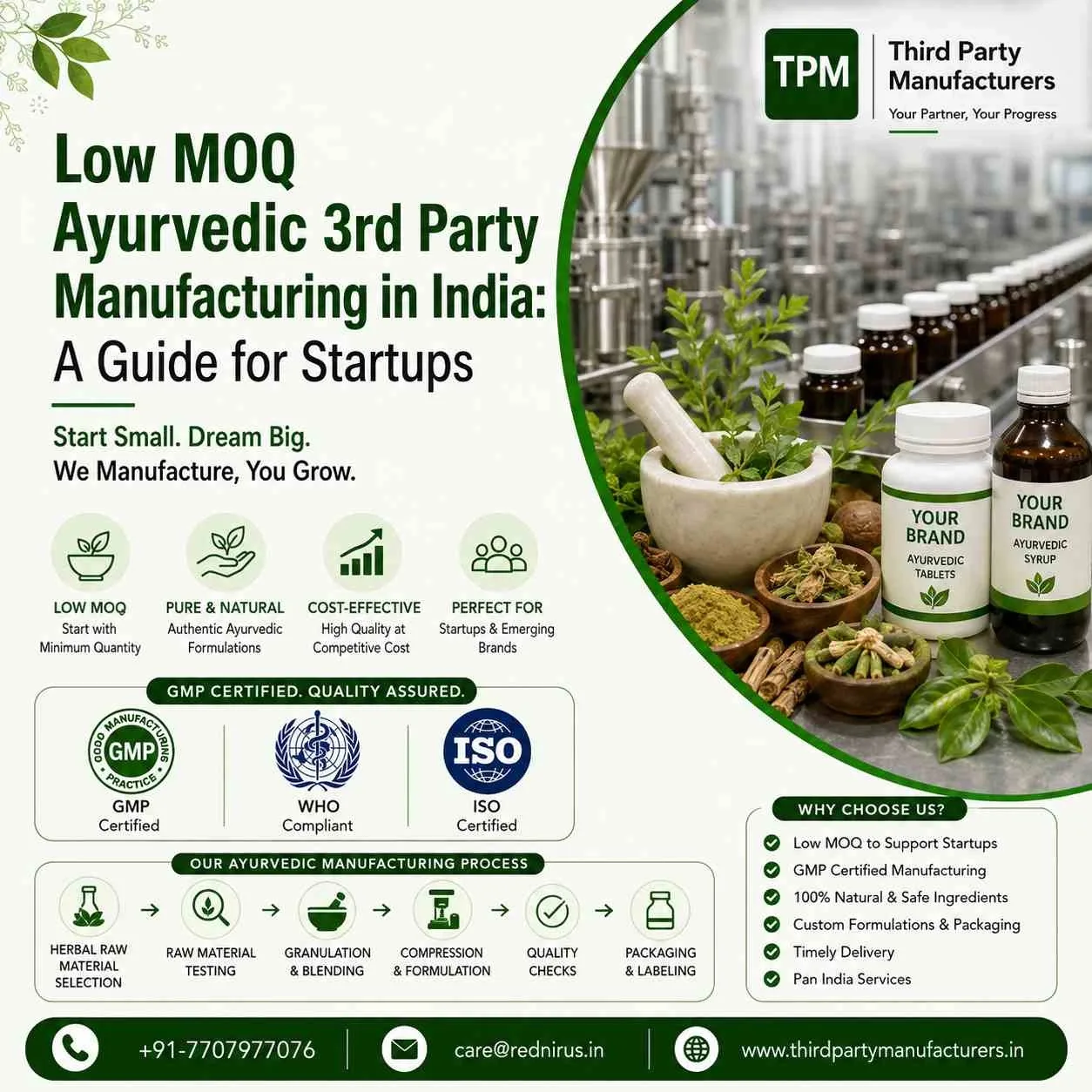
Low MOQ Ayurvedic 3rd Party Manufacturing in India allows startups to produce Ayurvedic products in smaller quantities without investing heavily in manufacturing infrastructure. It supports market testing, reduces inventory risks and enables businesses to launch products gradually while working with manufacturers for formulation, production, packaging and quality compliance.
Ayurvedic 3rd Party Manufacturing is now the easy way for modern day wellness founders to expand the product range without needing to own a single piece of equipment. Instead of investing crores in setting up a GMP certified unit, one could simply team up with a reputed unit that already possesses the right formulations, equipment and certification in order to start their operations. This path has provided entry into the world of herbal products for entrepreneurs, wellness influencers, dieticians and even the home-grown startups that started with one hero product. The best part about taking this road is the availability of reduced MOQs in recent times, which ensures that the founder need not spend lakhs of rupees in booking a complete production batch just to gauge the viability of the concept in the market. The whole idea has become much easier to understand due to this choice.
What is Ayurvedic 3rd Party Manufacturing and Why Startups are Choosing It?
In layman's terms, Ayurvedic 3rd Party Manufacturing is the manufacturing of herbal products, capsules, syrups, oils, and skincare products for that particular brand with its brand name. This kind of manufacturing process is termed as Ayurvedic Contract Manufacturing or Ayurvedic Medicine 3rd Party Manufacturing. In accordance with this arrangement, the manufacturer offers its services to source raw herbs, formulate, manufacture, test and package, while the brand is responsible for its sales and distribution.
It is precisely this reason that makes so many startups lean towards working with the Third Party Ayurvedic Manufacturer rather than building their own factory. Setting up the Ayurvedic Manufacturing Company requires WHO-GMP compliant infrastructure, an Ayurvedic pharmacist, and a product manufacturing license in accordance with the Drugs and Cosmetics Act. Moreover, the company requires a significant amount of investment in machinery maintenance. For a startup in its initial stages that is trying to prove its worth, such a huge capital expense does not make sense. Therefore, partnering with an already functioning Ayurvedic Manufacturing Company will allow the entrepreneur to invest money into branding and marketing efforts.
It is also not a novel idea for the Indian pharmaceutical industry. The concept of third party manufacturing has been prevalent in allopathic medicine for years, and the concept has only been modified for the field of herbal and Ayurvedic medicines. Moreover, the core concept remains identical to that of 3rd Party Pharma Manufacturing, wherein the manufacturer contracts out the manufacturing process to a dedicated division while retaining complete control over the product identity and its marketing strategies. It helps the entrepreneur who is familiar with a pharmaceutical distribution venture into herbal and Ayurvedic medicines.
Why Low MOQ Matters for New Ayurvedic Brands?
Minimum Order Quantity is usually the largest problem to overcome for new brands. The traditional units that manufactured the Ayurvedic medicines demanded huge batches from 10,000 or even higher units per SKU, forcing the brand founders either to raise a serious amount of money at the start or to forget about their good product ideas. In recent years, however, a growing number of companies that manufacture Herbal Products through Third Party Manufacturing have accepted significantly smaller batch sizes – as low as 500 to 1000 units.
Manufacturing Ayurvedic products with Low MOQ opens new opportunities for startups. The brand is able to test three or four formulations in small quantities, see which of them will be successful and then produce only those. This saves resources, eliminates dead stock and allows to quickly adjust to the customers' needs. At the same time, such a method allows solo founders or small teams that do not have any institutional backing but have a product idea and specific target audience to enter the market.
In addition to this, there is the financial advantage of having cash on hand that entrepreneurs usually neglect. The money required for large-scale manufacturing remains tied up for many months, especially if the company does not yet have a supply chain set up. With low minimum order quantities, the same money can be used for packaging, collaborating with influencers, or performance marketing, all of which can have a much bigger effect on revenue in the early stages of business operations.
How to Choose the Right Third Party Ayurvedic Manufacturing Company?
This is because not all manufacturers offering MOQ products guarantee quality products, hence the need for conducting thorough research. While choosing a Third Party Medicine Manufacturer, the startup should pay attention to the certifications of the facility, portfolio of previous clients and the possibility of providing sample batches before ordering. A genuine Top Third Party Ayurvedic Manufacturer would provide a clear account of their licenses of manufacture, source of the raw materials and how laboratory tests are carried out. They would not have any problems organizing a tour of the facility.
It would be advantageous to establish the areas of specialization in the unit. There are those units that are concerned with manufacturing classical Ayurvedic medicines such as churna, tablets, and syrups, while others specialize in cosmetic production of Herbal Products Manufacturing such as face washes, hair oils and body lotions. It will help reduce errors in the formulation stage when the right manufacturer is chosen depending on the type of product. Checking client testimonials, GST registration and turnaround time of a Third Party Manufacturing Ayurvedic Product are other vital things to consider.
Another aspect of communication is something that can be easily overlooked as well. A manufacturer who answers your questions instantly, gives you a proper timeline and updates you about the status of your order is much more pleasant to deal with than a slightly cheaper one with bad coordination. Successful founders usually emphasize that reliable manufacturers act more like your co-pilot in the beginning rather than a vendor and give advice regarding packaging, product expiry date, and other issues related to exporting.
Range of Products You Can Launch Through Ayurvedic Contract Manufacturing
One of the greatest benefits of this model of business is the vast range of products that a startup can introduce into the market without any involvement in manufacturing processes. Some of the traditional formulas provided under Ayurvedic Manufacturing include churna, kwath, arishta, asava, bhasma, and guggulu tablets used for improving digestion, immunity, and joint problems. Besides traditional medications, all the Herbal Manufacturing Company structures usually provide such wellness items as wellness capsules, herbal syrups, protein and nutraceutical mixtures, and functional teas.
Personal care is one more rapidly developing area of interest. Often, startups seek the services of a manufacturer as Ayurvedic Skin Care Products Manufacturers offering such cosmetics as face packs, herbal soaps, anti-acne gels, hair oils with bhringraj or amla and organic sunscreens. As consumer demand for such products free from chemicals increases, this sphere became one of the most in-demand areas in Herbal Third Party Manufacturing. A reliable partner should always be ready to make changes in formulations in terms of fragrance, texture or active components to fit brand positioning better.
Certifications, Quality Standards, and Compliance to Check
Quality assurance is where most first-time entrepreneurs misjudge the complexities of this sector. The genuine pharmaceutical manufacturer involved in Third Party Pharma Manufacturing and herbal products should possess WHO-GMP, ISO, and AYUSH Premium Mark certifications as applicable. This is an indication that raw material is tested for heavy metals and microorganisms, batch information is recorded correctly, and stability testing is performed on finished goods before dispatch.
In addition, the new company needs to ensure that there is a license to manufacture the products under the Drugs and Cosmetics Act or a skin/hair care range under the appropriate cosmetic regulations. The responsible Ayurvedic Third Party Manufacturer will always provide a certificate of analysis on each batch produced and also be willing to show test results upon request. Avoiding this step in an effort to save time might cause serious problems later. This includes regulatory action against your company, loss of customer confidence in case you fail in the quality tests of the products post-launch. In essence, choosing the Best Ayurvedic Products Manufacturer for your speciality is not about getting the best quote, but about maintaining quality.
Steps to Start Your Partnership with an Ayurvedic Manufacturer
The initial stages have a certain structure after you have understood how it should be done. Firstly, finalize the product concept and category of the product, whether it is classical medicine, nutraceuticals or personal care. Secondly, choose two or three manufacturers who produce Ayurvedic Products Manufacturing under low MOQ terms and ask them for product catalogues, pricing and certificates. Thirdly, ask for samples and evaluate the texture, aroma, packaging and shelf life of the product before you finalize the formula.
After you are satisfied with the samples, start negotiating about MOQ, price per unit, payment terms and delivery period via a manufacturing agreement. It should also be noted that many founders get their brand name registered and apply for a trademark during this phase because the manufacturer will print the packaging of the brand according to the order. The last step will be the first manufacturing run and then monitoring of the product through regular updates from the manufacturer. Using this stock, you will be able to evaluate the demand for the product before placing further orders.
Frequently Asked Questions
Q1. What is the general low MOQ for Ayurvedic manufacturers nowadays?
Currently, most manufacturers will take orders from five hundred to one thousand units per SKU, unlike the older standards of a few thousand units per SKU. This makes it easy for startups to trial products without much money at stake.
Q2. Is there any regulation for Ayurvedic 3rd Party Manufacturing in India?
Yes, it follows the laws of the Drugs and Cosmetics Act and AYUSH. Both the manufacturers and the brand need to be licensed before entering into a manufacturing deal.
Q3. Is it possible for a startup to use the same manufacturer for its skin care products?
There are some manufacturers who manufacture both types of products, but it is better for you to go for a manufacturer that specializes in your particular product type.
Conclusion
Low MOQ Ayurvedic 3rd Party Manufacturing has truly transformed how wellness brands are made in India. It provides founders with the flexibility to try out their concepts, introduce several SKUs and scale at a rate that corresponds to the real demand rather than being under the compulsion of producing a high volume at once. No matter if you are trying out classic formulations, nutraceuticals or herbal skincare, working with an accredited and transparent manufacturing partner is the most important thing you have to do in this process.
Must Read: Regulatory Updates Affecting Pharmaceutical Third Party Manufacturing in 2026-27
What is Ayurvedic 3rd Party Manufacturing and Why Startups are Choosing It?
In layman's terms, Ayurvedic 3rd Party Manufacturing is the manufacturing of herbal products, capsules, syrups, oils, and skincare products for that particular brand with its brand name. This kind of manufacturing process is termed as Ayurvedic Contract Manufacturing or Ayurvedic Medicine 3rd Party Manufacturing.
Low MOQ Ayurvedic 3rd Party Manufacturing in India allows startups to produce Ayurvedic products in smaller quantities without investing heavily in manufacturing infrastructure. It supports market testing, reduces inventory risks and enables businesses to launch products gradually while working with manufacturers for formulation, production, packaging and quality compliance. Ayurvedic 3rd Party Manufacturing is now the easy way for modern day wellness founders to expand the product range without needing to own a single piece of equipment. Instead of investing crores in setting up a GMP certified unit, one could simply team up with a reputed unit that already possesses the right formulations,...
Key takeaways
- What is Ayurvedic 3rd Party Manufacturing and Why Startups are Choosing It?
- Why Low MOQ Matters for New Ayurvedic Brands?
- How to Choose the Right Third Party Ayurvedic Manufacturing Company?
- Range of Products You Can Launch Through Ayurvedic Contract Manufacturing
- Certifications, Quality Standards, and Compliance to Check
- Steps to Start Your Partnership with an Ayurvedic Manufacturer
How to order Low MOQ Ayurvedic 3rd Party Manufacturing in India: A Guide for Startups
- Define the product Fix the composition, dosage form, pack size, quantity and your brand name.
- Shortlist manufacturers Compare WHO-GMP certification, product permission, capacity and location.
- Compare quotations Ask for the per-unit rate, MOQ, lead time and packing material cost in writing.
- Approve artwork and sample Finalise label, carton and MRP, and approve the pre-production sample.
- Receive your batch Pay the agreed advance and receive goods with invoice and certificate of analysis.